
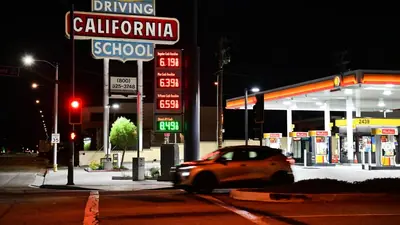
The International Energy Agency has projected that the recovery of oil flows from the Middle East will extend into next year. This forecast comes as escalating attacks on Gulf shipping and ongoing threats from Houthi forces in the Red Sea continue to put pressure on vital energy routes. The current geopolitical tensions are causing uncertainty in the energy market, impacting supply stability and pricing forecasts for the region.
Refinery Margins Surge Amid Supply Shortages and Rising Fuel Prices
According to the latest monthly report from the agency, steep losses in petrochemical feedstocks and refined product supplies, coupled with increasing fuel prices—particularly for diesel—are expected to continue impacting consumption levels. The report highlights that gasoline, diesel, and other fuel prices have escalated significantly more than crude oil prices, leading to a widening gap between feedstock costs and product prices. This shift has resulted in refinery margins in the Atlantic Basin reaching record levels, underscoring the financial pressures within the industry.
Global observed oil stocks have fallen by about 2.8 million barrels a day on average since the start of the war, according to the IEA. In August alone, inventories declined by 3.1 million barrels a day. Global oil supply fell by 1.6 million barrels a day last month. For the year as a whole, the IEA now expects global supply to decline by 5.7 million barrels a day, deeper than its previous forecast for a drop of 4.3 million barrels a day. The oil market entered the crisis with a surplus of more than 1 million barrels a day. Exports through the alternative ports of Yanbu and Fujairah rose to 7.8 million barrels a day in June from 4.1 million barrels a day in February, before attacks by the Yemen-based Houthi militants in the Red Sea pushed flows back to 5.5 million barrels a day in August, the IEA said. The additional volumes shipped through those routes have offset more than 500 million barrels of lost flows through the Strait of Hormuz, or about 2.8 million barrels a day. Gulf oil production and exports remain severely restricted, while flows through the Strait of Hormuz averaged just 7.6 million barrels a day in August—13.1 million barrels a day below prewar levels. The IEA’s outlook improves sharply in 2027. Global oil demand is expected to return to growth, rising by 2.6 million barrels a day, while supply is expected to surge by 8 million barrels a day. OPEC and its allies are expected to account for 5.5 million barrels a day of that increase, with producers outside the group contributing another 2.5 million barrels a day. The report came after oil prices soared above $100 a barrel this week for the first time since July, as escalating U.S.-Iran clashes and renewed strikes by the Iran-allied Houthis on Saudi Arabia deepened fears of prolonged supply disruptions.
At the same time, inventories that have helped cushion the shock are being depleted at unprecedented rates. When shipments through the Strait of Hormuz were disrupted, Saudi Arabia and the United Arab Emirates quickly rerouted oil through alternative export routes, helping to limit the initial hit to global supply. But more than six months into the conflict, the workarounds are coming under pressure. The scale of current traffic is difficult to determine, with some tankers sailing through the strait with their tracking systems turned off.
The waterway was a vital conduit for global energy supplies before the war, carrying about one-fifth of the world’s oil and liquefied natural gas to overseas markets.
Brent crude, the global oil benchmark, was trading above $105 a barrel in early European trading Friday, while West Texas Intermediate hovered around $101 a barrel. That divergence underscores where the market is tightest. Refiners are earning high returns as fuel prices outpace crude costs, giving them a strong incentive to maximize production even as the broader oil system remains constrained. A prolonged conflict has also raised the risk of a fresh wave of energy-driven inflation, as higher fuel costs filter through to households, companies and the wider economy. Write to Giulia Petroni at [email protected]
