
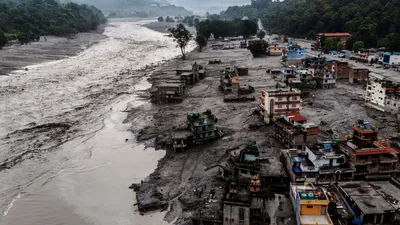
Recent flash floods in Nepal and Tibet were triggered by an ice-rock avalanche, according to a preliminary report from the Nepal Environment Society. However, scientists have indicated that the primary cause of the flooding was glacier mass wasting. This phenomenon involves the melting and collapsing of glaciers, which can lead to significant water release and subsequent flooding in surrounding areas.
New Findings on Flash Floods Linked to Ice-Rock Avalanche
A recent report released on Sunday indicates that satellite imagery shows no signs of a glacial lake outburst flood (GLOF), which had previously been proposed as the cause of the recent flash floods. Instead, the preliminary study identifies an ice-rock avalanche as the primary trigger for the devastating flooding events.
As per scientists, the mass began falling around 8:37am local time on Wednesday, August 26. “The avalanche triggered ground vibration created a strong seismic signal (M5.2). The ice-rock avalanche with debris descended to ~2930 at Lhende Khola (border between China and Nepal) from 5200, sharply falling 2270 m, generating speed debris flow,” states the study. “Analysis of several satellite images, including Gaofen-1 (GF-1), SAR, Sentinel, PlanetScope, and Landsat images, indicates the presence of three glacial lakes upstream in the Tibet region. Earlier reporting noted: The study found that a huge mass of ice, rock and debris fell from around 5,200 metres in the Langtang–Lirung area of Rasuwa and entered the Lhende River.
Due to this, steep terrain descended from a height of 5,200 meters before reaching the Lhende River. Due to evidence of mass wasting, the scientists have further warned that the probablity of flash floods events may increase, especially in the Himalayan region. The surge then travelled downstream through the Bhotekoshi and into the Trishuli, generating a powerful debris-laden flood, My Republica reported.
Earlier reporting noted: Nepal floods triggered by ice-rock avalanche: Nepalese scientists Kathmandu, The devastating floods in Nepal that swept through the Bhotekoshi–Trishuli corridor were triggered by a massive ice-rock avalanche in the high Himalayas, not by conventional rainfall, according to a preliminary report by Nepalese scientists. Scientists added that prior to the floods, the water levels of the rivers Rasuwaghadi and Saprubesi had reduced, indicating a possible upstream blockage in the Lhende River. Despite this finding, the study added that the size of the blocked dam and the river blocking have to be investigated further. However, no evidence and indicators of a glacial lake outburst flood were identified,” the study notes.
Earlier reporting noted: The report, commissioned by the Nepal Environment Society , was released on Sunday.
