
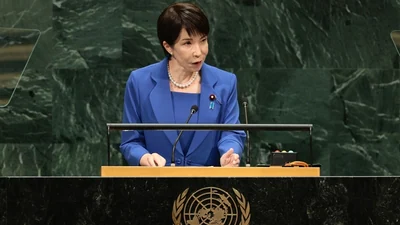
TOKYO—Japanese Prime Minister Sanae Takaichi has urged the United Nations to amend its charter by removing references to nations defeated in World War II as ‘enemy states.’ This call comes in response to recent actions by China and Russia, which have used the term to exert pressure on Japan regarding its plans to increase defense spending. Takaichi’s remarks highlight the ongoing geopolitical tensions in the region and Japan’s efforts to bolster its military capabilities.
A 2005 resolution by the U.N.
In addition to U.S.-Japan relations, Takaichi and Trump discussed economic security, according to Japanese officials, a term that encompasses efforts to reduce the two countries’ reliance on Chinese supply chains as Beijing increasingly exploits its control of critical minerals in pursuit of political goals. Tokyo has been the target of sustained pressure from Beijing for months, after Takaichi said late last year that Japan could get involved in any conflict over Taiwan, a self-ruled island democracy that Beijing says is part of China and has vowed to take by force, if necessary. In her maiden speech at the U.N., Takaichi said the charter was drafted 81 years ago and the clauses “must be deleted,” given Japan’s contributions to the U.N. over the past seven decades.
Her request, in a speech Tuesday to the United Nations General Assembly, followed a brief summit with President Trump on the sidelines of the U.N. gathering ahead of Trump hosting Chinese leader Xi Jinping for a state visit in Washington. General Assembly resolved to remove the enemy state clauses but has never been acted on, as changing the charter requires the approval of the five permanent members of the U.N. Security Council, which include China and Russia.
Japan’s Role in Global Peacekeeping Highlighted by Takaichi
Japan has marked 70 years as a U.N. Member State, emphasizing its commitment to international peace and prosperity. In a recent statement, Takaichi underscored Japan’s identity as a peace-loving nation, noting its adherence to an exclusively defense-oriented policy. This approach has guided Japan’s contributions to global stability over the decades.
