
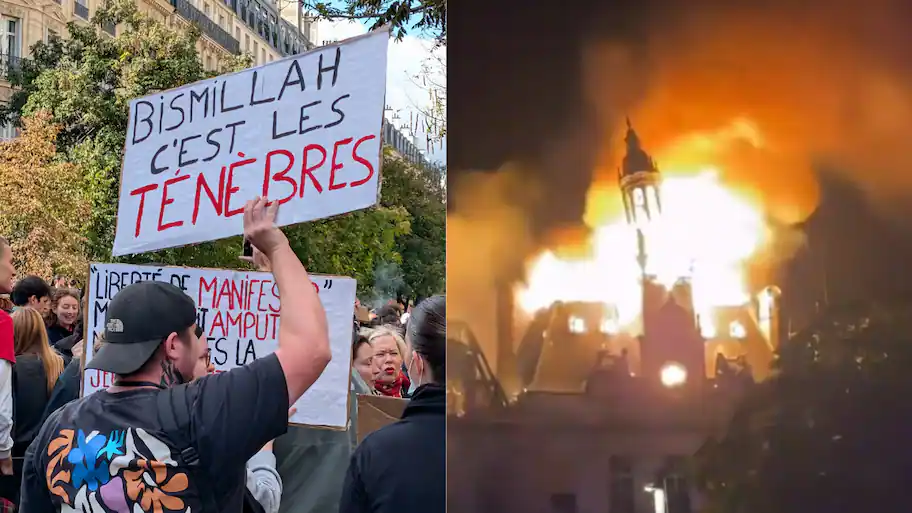
What began as student-led protests in France over education budget cuts and poor school conditions rapidly expanded into wider demonstrations against the rising cost of living, triggering violent clashes with police, mass arrests and a strong response from the government.
Together, the expression can be rendered loosely as “In the name of God, it is darkness”, while there is no definitive meaning of the phrase. Its precise meaning and intended message, however, depend on the context in which it is used.
French Prime Minister Sébastien Lecornu said police arrested 1,200 protesters on Saturday, while 150 personnel were injured, reported news agency ANI, citing France24. The scale of the unrest became clearer on Saturday, when Lecornu said 1,200 protesters had been arrested and 150 personnel injured during demonstrations across France. In Paris, police detained 855 people, a figure described by authorities as a record, France24 reported. French Interior Minister Laurent Nunez had earlier told France24 that 550,000 people participated in the protests against declining purchasing power, including 110,000 demonstrators in Paris. He also said police had arrested 400 protesters over vandalism charges. The expression gained further visibility after Swedish climate activist Greta Thunberg used it during a demonstration outside a high school in Seine-Saint-Denis on Tuesday, October 13, according to NewsFire. The Yellow Vest movement began in 2018, bringing thousands of people on to the streets over rising fuel prices and economic inequality. More than 2,500 protesters and 1,800 police personnel were injured in the clashes, according to a report by ANI. In Limoges, a major fire at the town hall, a building that is 143 years old, was contained, France24 reported, citing a local media channel.
That theory, however, has not been confirmed. French media have also reported that figures associated with the Yellow Vest movement are preparing to join demonstrations in support of high-school students. The latest unrest has also extended beyond France, with clashes between demonstrators and police reported in Belgium and Italy.
“Bismillah c’est les ténèbres” is a French-Arabic expression. “Bismillah” is an Arabic phrase meaning “in the name of God”, while “c’est les ténèbres” translates roughly as “it is darkness” or “this is darkness”. “We have reached a level of violence that I believe we had never seen before,” El Aaraje said, according to the report. In a post on X, Macron said those responsible for attacks on public institutions and businesses would face prosecution and punishment. The expression emerged from Snapchat group chats used by French high-school students organising demonstrations, according to a report published by NewsFire. The report, citing French publication Valeurs Actuelles, said screenshots of a conversation circulated widely on social media, drawing attention to the phrase and its provocative wording. Algerian flags also appeared alongside the messages, according to the report. She concluded her remarks with the phrase “Bismillah, c’est les ténèbres”, accompanied by a hand gesture, the report said. Against this backdrop, “Bismillah c’est les ténèbres” has become more than a phrase circulating online.
Amid the unrest, the phrase ‘Bismillah c’est les ténèbres’ has emerged as a talking point, attracting attention through online videos and discussions linked to confrontations between protesters and law enforcement. The slogan has also sparked debate over its meaning and use as demonstrations over education, economic pressures and alleged excessive police force continue across the country. The phrase has attracted attention through online discussions and videos linked to the French protests, with its wording becoming part of the wider conversation surrounding demonstrations and confrontations with police. Its appearance in protest-related footage has also raised questions about the language and slogans being used by demonstrators. However, the phrase alone does not establish the political or religious affiliations of those chanting it, nor does it explain the motivations of the wider protest movement. The protests themselves have centred on several grievances, including education budget cuts, school conditions, the rising cost of living and allegations of excessive police force. These issues have brought students and other demonstrators on to the streets, with incidents of vandalism and violence prompted authorities to take a tougher line. The capital also witnessed serious confrontations, with Deputy Mayor Lamia El Aaraje describing the violence as unprecedented. The figures reflect the scale of the demonstrations, which have moved beyond student concerns about schools and education spending to encompass wider dissatisfaction with economic conditions. The unrest has also placed pressure on the authorities to distinguish between peaceful demonstrations and acts of violence. The attack on public buildings, looting and damage to businesses have drawn condemnation from government officials. French President Emmanuel Macron has issued a firm warning to those involved in violence, vandalism and looting during the ongoing demonstrations. He also expressed support for law enforcement personnel, describing them as guarantors of the right to demonstrate. “No room for violence in our Republic. Those who have broken, attacked the prefectures as well as businesses, looted even our town halls, will be prosecuted and punished. To the law enforcement forces, guarantors of the right to demonstrate, I express the support of the Nation. We will all stand united against the sowers of chaos, who seek only to bring down our institutions and prevent those who peacefully express their demands from doing so,” he wrote. Macron’s statement sought to draw a distinction between those exercising their right to protest peacefully and those accused of attacking public property or disrupting institutions. The government’s response comes as student-led demonstrations continue to highlight concerns over school conditions, budget reductions and the cost of living. Protesters have also denounced what they regard as excessive use of force by police. The messages included language associated with French youth culture and calls to join school blockades. Some young activists initially suspected that the messages might have been written by police officers posing as teenagers to infiltrate student groups. The wording was subsequently shared and parodied online. Students began using it as a slogan directed against law enforcement, turning an expression that had attracted attention on social media into a rallying cry at demonstrations. The slogan has since appeared on protest placards, including designs featuring red and black backgrounds, lightning bolts and devil horns. Its spread illustrates how language originating in online exchanges can acquire a different meaning when adopted by demonstrators on the streets. Thunberg had travelled to France to support the student movement. Speaking at the demonstration, she criticised the treatment of students by police and argued that young people were facing extreme brutality while demanding their fundamental rights. Her use of the slogan brought additional attention to an expression that was already circulating among protesters. It also highlighted the tension between the slogan’s adoption as an anti-police chant and its use of a religious invocation. the phrase has drawn criticism from people who believe it makes inappropriate use of an Islamic expression While some students have used the words to mock the police. The slogan’s rise has coincided with a broader wave of demonstrations in France, initially driven by students’ objections to education budget cuts and what they describe as unacceptable school conditions. The protests have also focused on the cost of living and declining purchasing power, bringing wider economic grievances into the movement. Demonstrators have denounced what they regard as excessive police force, while the authorities have condemned violence and attacks on public property. Those protests were marked by clashes with police, during which rubber bullets were fired. The incidents have intensified concerns about public order as the French government faces pressure to respond to demonstrators’ demands while addressing violence and vandalism. For Macron, the challenge is to protect the right to peaceful protest while ensuring that those responsible for criminal acts are held accountable. For the demonstrators, the central issues remain education, economic pressures and the conduct of law enforcement. Its adoption by some student protesters, its use by Thunberg and the criticism it has attracted have made it a symbol of the competing tensions surrounding the demonstrations, from anger at the police to disputes over religious respect and the boundaries of political expression. The expression’s popularity does not, by itself, explain the wider movement or establish a common ideology among those taking part. Instead, its trajectory highlights how a slogan born in online conversations can become a recognisable feature of street protests, while also generating controversy far beyond the original context in which it appeared.
