
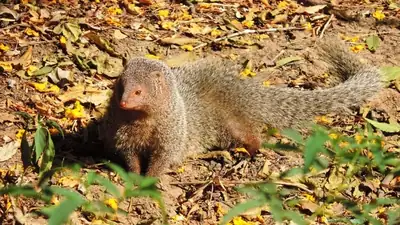
A small carnivore introduced to control venomous snakes multiplied, spread through the forests, and began preying on species conservationists were trying to protect. An attempt to solve one wildlife problem on a remote Japanese island created another. Decades later, removing it required an island-wide campaign involving traps, cameras, detection dogs, and years of monitoring.
Six years without a confirmed mongoose
Around 30 small Indian mongooses were brought from Okinawa to Amami Oshima in 1979 and released near Naze to control habu vipers, according to Japan’s Ministry of the Environment . By 2000, the mongoose population was estimated at 10,000. After years of intensive eradication work, the ministry declared the species eradicated from the island on September 3, 2024, after no confirmed mongoose had been detected since the last one was captured in April 2018. Amami Oshima’s rugged terrain and dense subtropical forests provided extensive habitat for the adaptable predator, allowing it to spread across much of the island, which covers about 712 square kilometers. The local government began a capture campaign in 1993, and the Environment Agency and Kagoshima Prefecture launched a mongoose control program in 1996. More than 30,000 traps were deployed at high density across the island, including forested areas away from roads. More than 300 camera traps were also used, while trained detection dogs helped locate animals that had become increasingly difficult to find. The last confirmed animal was captured in April 2018. Camera traps, detection dogs and traps were used to look for evidence of surviving animals through the end of fiscal 2023. The Ministry of the Environment said the models estimated a 99.7% and 98.9% probability that the mongoose had been eradicated. Based on these results and an expert review, the mongoose was formally declared eradicated from Amami Oshima in September 2024.
Because the habu, a venomous pit viper native to the region, threatened people, people brought the mongoose to Amami Oshima. Because other environmental pressures and introduced species were involved, the researchers also cautioned that historical changes could not always be attributed to mongooses alone. Because the animals also lived in forested and mountainous areas, capturing mongooses near roads was not effective. Because an absence of captures does not automatically prove that every individual has disappeared, that was. Japan therefore continued searching and monitoring after the final capture.
The consequences became clearer as the mongoose spread beyond the area where it had originally been released. The idea was straightforward: introduce a predator that could hunt the snakes and perhaps reduce their numbers. But the mongoose did not restrict itself to habu. It is an opportunistic carnivore that can eat a wide range of prey, from insects and other invertebrates to frogs, rodents, and other small vertebrates. Amami Oshima, meanwhile, has an unusually high concentration of species found nowhere else. A study in Biological Invasions found that the expansion of mongoose distribution was associated with reductions in the distribution of several native animals, including the endangered Amami rabbit. Organized efforts to control the mongoose began only after reports of damage to farms and livestock. These measures only showed how challenging the situation was. The scale of the operation grew steadily. The campaign was not just about catching as many mongoose as possible. Teams repeatedly adjusted trapping methods to reduce accidental captures of native wildlife and combined several methods as the mongoose population became smaller. A study in the Journal of Applied Ecology used mathematical modeling to reconstruct the mongoose population and assess how management affected its decline. The work highlighted the importance of sustained removal and monitoring when trying to eliminate an invasive population spread across a large, rugged island. By the late stages of the campaign, finding even a single mongoose had become exceptionally difficult. But officials did not immediately declare victory. A few animals could potentially survive undetected in remote forests, reproduce, and restart the population. The final assessment used two statistical approaches to estimate the probability of eradication.
