
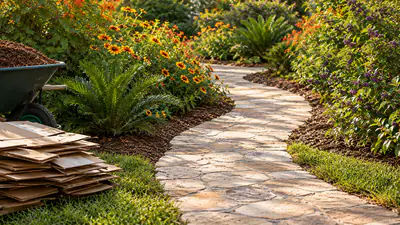
That’s what one Florida homeowner did, according to The Cool Down . Imagine a front yard that is thin and patchy, always asking for more water and attention. Now imagine fixing it with old cardboard. The front-yard transformation was shared on YouTube by the person behind Food Forest Florida, who showed how a normal lawn had been transformed into what he called a Florida-friendly native pollinator garden.
An article in Environmental Management published in 2005 estimated that turf grasses are grown on as much as 163,800 square kilometers of the continental U.S. Because many cities face pressure on freshwater, but that benefit depends on heavy watering and fertilizing, and the researchers suggested that water conservation practices such as xeriscaping might need to be expanded.
The Food Forest Florida creator said the garden is designed to provide food for animals as well as for people. The design was also modeled after a low-maintenance Florida oak hammock, a type of hardwood forest in the state, the creator said. One commenter said they have a love-hate relationship with grass and have been replacing it piece by piece with new beds. Another said they wished more people would replace monoculture lawns. Traditional lawns can be expensive, time-consuming, and surprisingly resource-heavy, says The Cool Down.
With the base laid, the space began to take shape. Curving stone walkways and edging were put in, followed by a mixture of native and naturalized plants intended to attract birds and pollinators. Edible plants were part of the plan too. In dry or sandy climates, maintaining green grass can boost water bills with little benefit to local ecosystems. The scale is larger than most people realize. That’s about three times the area of irrigated corn, the largest irrigated crop. Lawns do offer some ecological upside: the researchers noted that well-watered and fertilized turf can act as a carbon sink.
In a 2018 PNAS study , researchers studied Carolina chickadees in yards throughout the Washington, D.C. area. Authors Desirée Narango, Douglas Tallamy, and Peter Marra found that chickadee populations could only be sustained in yards where more than 70 percent of plant biomass was native. Put another way, nonnative plants had to make up less than 30 percent.
The Cool Down notes that native plants are often more compatible with local soil and weather , which can result in less watering, less maintenance, and lower costs in the long run. They also provide habitat for pollinators and birds. The bird claim is supported by research. Biomass is the total sum of plant material. The study only looked at one bird species in one region, so it can’t predict what will happen in every yard. But it does show that what plants are chosen can affect the food available for wildlife. Lawn replacement does not have to be all or nothing. The Florida makeover shows that it can be done in phases. Even replacing part of a lawn can save homeowners money and reclaim time. Homeowners could start with a curb strip, a corner bed, or a space around trees. Alternatives include native plants, clover, buffalo grass, or xeriscaping, depending on the region. This can reduce constant maintenance while making a yard more resilient. Whatever you do, start small, be patient, and see who shows up.
