
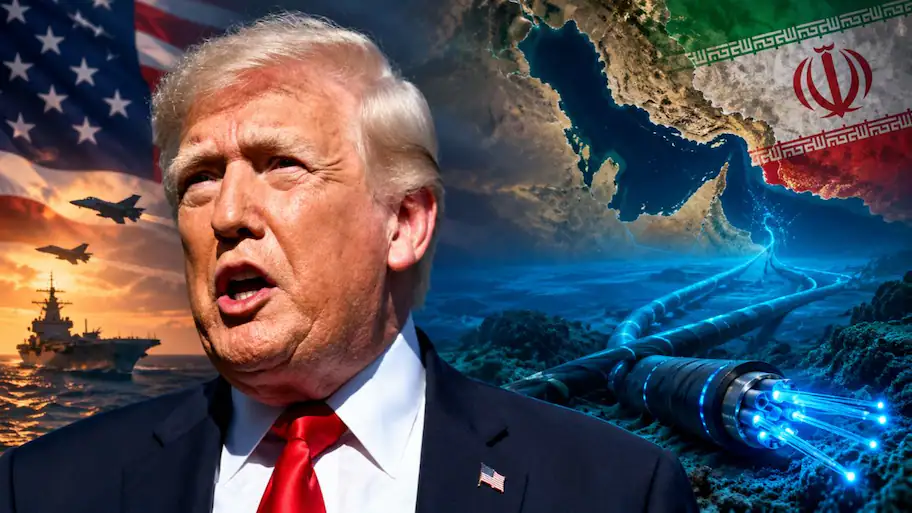
US President Donald Trump has suggested another military strike on Iran, while Iranian officials have warned that they could retaliate by damaging internet cables beneath the Gulf. Any attack on these cables could disrupt banking, online services and communications across parts of the Middle East. The warnings came on Friday as efforts to end the eight-month conflict struggled to advance.
The reference was to Operation Epic Fury, the US military campaign launched against Iran on February 28. Microsoft has announced plans to invest more than $400 million in undersea and land-based connectivity across the Middle East by 2030. He did not say when any new attacks might happen or what they would target. The warning comes as Gulf states spend heavily on data centres and artificial intelligence facilities. Iranian strikes damaged two Amazon Web Services sites in the United Arab Emirates in March and infrastructure near another facility in Bahrain was also hit.
At a rally in Fort Myers, Florida, on Friday, Trump said, “We may do another little Epic Fury.
His comments came despite a statement earlier this month that the United States would not attack Iran before the November 3, midterm elections. Undersea fibre-optic cables move data between countries, carrying around 99 per cent of global internet traffic, according to the International Telecommunication Union. But less than 1 per cent of international bandwidth passes through the Strait of Hormuz, telecommunications researcher Alan Mauldin of TeleGeography told media outlets.
“If Iran is attacked, there will be no more red lines,” one official said. Separately, Yadollah Javani, the political deputy of Iran’s Revolutionary Guards, said seven major internet cables under the Strait of Hormuz could be targeted if Iranian infrastructure came under attack. Turkish Foreign Minister Hakan Fidan said fresh attacks on Iran would spread the war and argued that negotiations offered the only credible route to ending it. French Foreign Minister Jean-Noel Barrot warned that further escalation could drive oil prices higher, while Germany said European powers were ready to discuss Iran’s nuclear programme.
Rising fuel prices have placed new pressure on his administration as voters prepare to choose the next Congress. The official also threatened military installations.
Earlier in the day, Trump argued that Washington had the ability to end the conflict quickly, but suggested it could instead allow the fighting to wind down. Meanwhile, Foreign ministers from Turkey, Egypt, Pakistan, Saudi Arabia, Britain, France, Germany and Italy met in Istanbul on Friday.
