
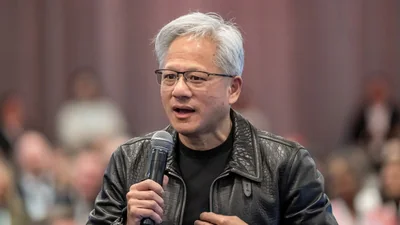
Nvidia Chief Executive Officer Jensen Huang renewed his pushback against AI doomsday scenarios, saying in an interview that the technology doesn’t pose an extinction risk to humanity.
Left unchecked, it could outrun our ability to understand and control these systems, and so must be pursued very carefully, if at all,” Dario wrote in an essay on September 12.
There is a “0 per cent chance” that AI brings about the end of the world, as predicted by some industry experts, according to Huang. Huang, whose company is the leading provider of AI processors, has also argued against the need for new regulations and said the development should proceed as quickly as possible. During multiple appearances at recent events, the CEO has reiterated his stance that artificial intelligence can be safely managed. He warned that the researchers building AI “earnestly believe that it could kill us all by the end of the decade. The debate has intensified in the industry after Anthropic CEO Dario Amodei advocated slowing the pace of AI model development , saying that if unchecked, it could outrun humanity’s ability to control such systems. “We must slow the pace at which we improve the capabilities of AI models…My first concern is that, since roughly this summer, AI has been advancing drastically faster, driven primarily by AI’s growing ability to build the next generation of AI. This dynamic is called recursive self-improvement, and it is starting to happen across the industry, including at Anthropic, as we and others have described. Amodei’s line of thought has also found endorsement from OpenAI’s Sam Altman and Google’s Demis Hassabis. But US President Donald Trump and Jensen Huang disagree, with both publicly backing the ongoing AI boom. Huang and Trump had a chat on the phone while the Nvidia CEO was on a stage at the All-In Summit in Los Angeles.
Former Anthropic researcher Jacob Coxon kicked off a wave of AI unease with his resignation earlier this month.
