
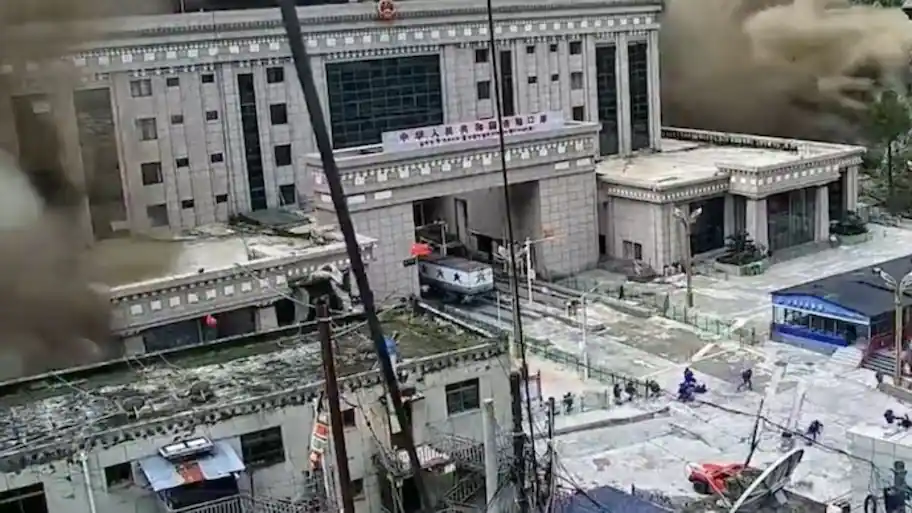
New Delhi: The devastating flash flood that hit the Nepal-Tibet border on August 26 has left more than 1,000 people dead in Nepal, with around 4,000 still missing. The disaster also struck areas on the Tibetan side of the border, where videos have shown floodwaters sweeping through settlements and damaging buildings.
Chinese authorities have confirmed 16 deaths in Tibet and said 546 people are missing. 261 of those reported missing are foreign nationals, according to officials. India’s Ministry of External Affairs said in an update issued at 9:30 pm on August 30 that around 500 Indian nationals are still on the Chinese side of the border and that all of them are safe.
But information coming from Tibet paints a far smaller picture of the disaster than the scale of destruction in Nepal. CCTV footage from the Gyirong Port border checkpoint offered a rare glimpse of the flooding in Tibet. The video showed people running as floodwaters rushed through the area. In one sequence, an entire building appeared to be swept away by the water. The footage went viral, including outside China. It also became a rare visual record of what happened on the Tibetan side of the border.
The organisation says at least 300 homes were destroyed in the flooding. The four villages of Sel, Serchung, Labi and Rizi were the worst affected, where around 300 homes have been destroyed and many people are still missing. The organisation said survivors have been taken to Gyirong, around 30 kilometres from the flood-hit border crossing. At a press briefing on Monday (August 31), Chinese Foreign Ministry spokesperson Guo Jiakun said rescue and relief operations had immediately begun and were being carried out in an organised manner. A similar pattern was seen after the Covid-19 pandemic emerged in 2020, when only limited information was allowed to reach the outside world.
Because the town is around 30 kilometres from the affected border crossing, the alleged movement of survivors to Gyirong is important. Because president Xi Jinping always wants to maintain stability in China, he said the calm response seen by the world is.
The International Campaign for Tibet says information from its sources suggests that the damage is far more extensive. Tanco Gyatso, president of the International Campaign for Tibet, told The Guardian, “What is visible in Nepal is what is being suppressed about Tibet. She said “the little information we have been able to get from the ground” suggests that the number of people affected is “much higher” than the number given by Chinese officials. Chinese authorities have rejected the aallegation that information about the disaster is being withheld and have said details are being transparently shared. “Attempts to deliberately smear China or exaggerate the situation by using the disaster will not win public support,” he said. The Cybersecurity Protection Bureau under China’s Ministry of Public Security said action has been taken against 10 people for spreading “false information”. The bureau warned that action would be taken against people who spread “false information about the disaster” that could mislead people. Most of the cases involved social media posts about deaths in Tibet, according to the bureau. Citing the bureau, Singapore-based news network Channel NewsAsia (CNA) reported all 10 people have given “administrative penalties”. It also said it has been difficult to get direct information from survivors. The organisation says those taken there are under close watch and have limited freedom to speak about what happened. Gyatso said the Chinese government’s handling of the latest disaster follows a familiar approach. China handles any kind of crisis as if there is no crisis,” she said. A journalist in Beijing said limited public response should not be read as a sign that the authorities are unconcerned about the disaster. It was a rare visit by the country’s second-highest leader so soon after a major disaster,” he said. China may also be concerned that the impact of the tragedy could become a bigger source of discontent, especially in a community where faith has played an important role for a long time,” he said. There have not been major protests in this area for a long time, but Tibetan groups overseas have expressed worries over increasing Chinese control, including a new education law which they say is intended to weaken the role of monasteries and Buddhism, according to him.
Independent verification of the damage in Tibet has been difficult. Foreign journalists face tight restrictions in the region and cannot freely travel there without government permission. This has left outside organisations dependent on limited information from people and sources in the affected areas. They are allegedly being kept under strict monitoring and are not being allowed to speak. The debate over what happened in Tibet has also moved to China’s handling of information about the disaster. Despite attempts to censor it, the Gyirong Port footage went viral. Chinese authorities have also allegedly taken action against people accused of spreading false information about the flood. Some posts claimed thousands of people have been killed or the number of missing people is higher than the official data. The bureau did not disclose the punishment given to each person or name the social media platforms where the posts appeared. There is still no clear estimate of the damage in Tibet. Tibetan organisations have shared information based on the inputs they have got from their sources in the affected areas. The International Campaign for Tibet claimed that hundreds of homes were destroyed. This is not the first time information coming out of China during a major crisis has been tightly controlled. “The Chinese government portrays it as if it is happening only in Nepal and that nothing has happened on this side of the border. She went on to allege that CCTV footage from Gyirong Port reached audiences across the world, while Chinese state television showed only one image from the footage. He highlighted the decision to send Chinese Premier Li Qiang to the affected area soon after the flooding. “Chinese Premier Li Qiang was immediately sent to the area. Footage showed him inspecting the removal of debris. “The Communist Party may fear that failing to respond to the disaster or failing to prevent it could increase public anger.
