
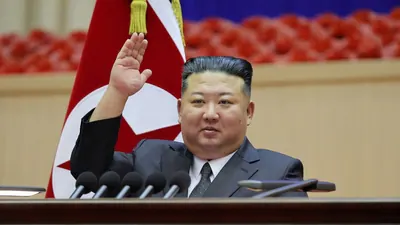
North Korean leader Kim Jong Un visited China on Saturday, inaugurating a new bridge that connects the two countries and saying he hoped to expand cooperation with his powerful neighbor.
President Donald Trump to revive their diplomacy, which broke down in 2019 during Trump’s first term.
Kim arrived in the Chinese border city of Dandong Saturday after crossing the newly opened bridge, according to South Korea’s Unification Ministry, which handles affairs related to North Korea and China’s official Xinhua News Agency. Kim said that his country “stands ready to work with China to carry forward their historical friendship and expand practical cooperation, thereby delivering tangible benefits to the peoples of both countries,” according to Xinhua. Wang then accompanied Kim to the bridge to send him off, according to Xinhua. Kim’s government has called for Washington to abandon its “hostile policy” and drop demands for the North’s denuclearization as a precondition for renewed talks.
He met with Wang Huning, a member of the Standing Committee of China’s Communist Party. The two toured a car factory, and promised to strengthen the bilateral relationship. North Korean state media did not immediately report on Kim’s visit and China’s Foreign Ministry press office did not respond to a request for confirmation. Chinese President Xi Jinping traveled to Pyongyang in June for a meeting with Kim. During their summit, Xi expressed Beijing’s willingness to expand bilateral cooperation in trade, agriculture, construction and technology, while Kim described ties with China as a top strategic priority. Kim has maintained a hard line toward Seoul and has so far rebuffed a proposal from U.S.
Experts said the opening of the New Yalu River Bridge this month was a key symbol of strengthening ties between North Korea and China and reflected their intent to expand trade, as it is expected to accommodate two-way traffic around the clock, including container shipments and heavy cargo trucks.
