
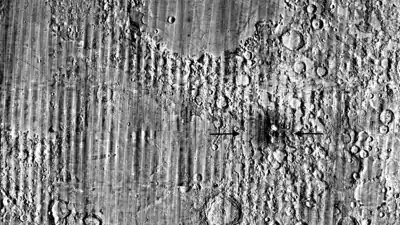
NASA’s Lunar Reconnaissance Orbiter (LRO) has identified a significant new crater on the Moon, named McGetchin. This crater measures 728 feet (222 meters) in diameter and reaches a depth of 141 feet (43 meters). Scientists believe it was formed by a rare impact event, described as a ‘once-in-a-century’ occurrence.
The impact that led to the formation of the crater may have occurred sometime between April 11 and May 22, 2024, according to the researchers who published a paper about their discovery in Science Advances.
Scientists say it is the largest newly formed crater yet discovered anywhere in the solar system, NASA said in a statement. The crater, roughly the size of two American football fields may have been created by a comet or an asteroid approximately the size of a three- to six-storey building that slammed into the moon, scientists have said. The crater appeared as a “large bright spot circled by a dark halo” by the LRO probe, which has been studying the Moon since 2009. He found an unusually large bright spot circled by a dark halo caught his eye, as it implied that surface material in that area had been shaken up, NASA said in a statement.
The discovery was made by the scientists of NASA during ‘routine data-quality check’ during which Robert Wagner, a scientist with NASA’s LRO, scanned a giant Moon map on his computer screen.
Discovery of the Largest Newly Formed Crater on the Moon
Recent analysis by Wagner has revealed the largest newly formed crater ever identified in the solar system, based on comparative before-and-after images of the Moon. This significant discovery highlights the impact events that shape lunar geology. Scientists estimate that such an impact occurs approximately once every century or even less frequently.
