
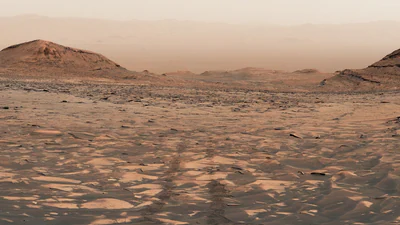
NASA’s Curiosity rover has achieved a significant milestone in its ongoing exploration of Mars, reaching an elevation gain of 1 kilometre as it ascends Mount Sharp. This accomplishment marks a notable point in the rover’s 14-year mission, during which it has provided valuable insights into the Martian landscape. Along its journey, Curiosity has captured stunning images that showcase the geological features of the planet, enhancing our understanding of its environment.
Curiosity landed inside Gale Crater on August 5, 2012, and began climbing Mount Sharp in 2014. The mountain rises roughly 5 kilometres above the crater floor and contains layers of sedimentary rock that preserve evidence of Mars’ changing environmental conditions. Because its rocks preserve evidence of a very different Mars in the distant past, scientists are particularly interested in Mount Sharp.
In July, NASA announced that the rover had discovered a large field of honeycomb-like polygonal fractures in the area. The latest panorama comes as Curiosity continues to encounter unusual geological features in Valle Grande. The patterns, some just a few centimetres across, could provide clues about processes that shaped the Martian surface. Curiosity has found signs that Gale Crater once contained lakes and streams and that ancient Mars had the chemistry and nutrients necessary to support microbial life.
NASA says the lower layers of Mount Sharp are older, while higher layers were deposited later, allowing scientists to study how the planet’s environment evolved over billions of years. As Curiosity climbs, it is effectively travelling through layers of Martian history.
