
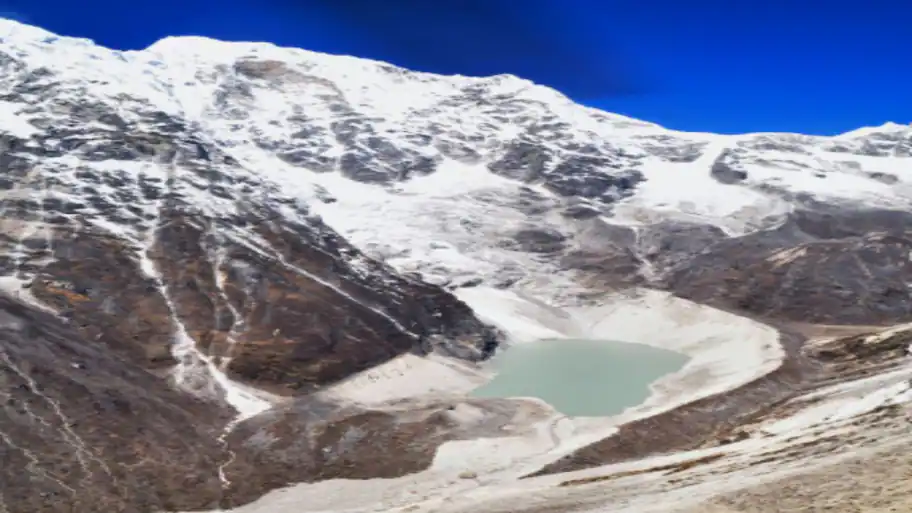
Kathmando: A newly formed glacial lake in Nepal’s Rasuwa district has accumulated an estimated 650,000 cubic metres of water and could pose a flood risk if it breaches, according to Nepalese officials citing data from China’s Ministry of Water Resources.
Flood Forecasting Division chief and senior hydrologist Binod Parajuli said Chinese data show that the lake has collected around 650,000 cubic metres of water by August 31. Therefore, there is a risk of it bursting,” he said. Known as ‘Lake Two’, it is located in the Langtang Lirung Himalaya area near the Nepal-China border. “This glacial lake is full.
When calculating the cubic metres of water, the depth could be around 10 metres,” he said. The amount of water presently stored in Lake Two is much smaller than the volume released during the August 26 flooding. Officials estimate that around 2 million cubic metres of water flowed towards Nepal during that event. Parajuli said a possible breach of Lake Two is not expected to push water beyond areas that are affected by the August 26 flood. Several landslides have been recorded since the point where the August 26 avalanche began and moved downhill, according to the senior hydrologist.
Because it increases the volume of water, not the area, “Depth is important. Because of the terrain below it, where small landslides, sediment flows and drainage channels could grow into larger flows if the lake breaches, parajuli said the smaller volume in Lake Two still poses a risk. “Due to leakage, some glacial lakes burst after one or two days.
“But, in the lower areas, there are small landslides, sediment movement in the river area and streams, so there is a risk that if this lake bursts, all those streams could become much larger,” he said. An additional risk is that landslides can occur at any time, and there are reports that this could have an impact at several levels,” he said. Parajuli said the timing of a breach can vary, with leakage causing some such lakes to burst within a day or two. Lake Two is in the process of filling, so there is a risk of it bursting,” he said.
The warning is relevant for rescue workers operating around tunnel areas and teams searching for people who died or went missing in the flooding. Authorities have called for extra caution in lower-lying areas where rescue operations are going on. “The only lake at risk of bursting is Lake Two, which has formed recently. Glacial lakes can become unstable as water accumulates and pressure increases.
The glacier that broke on August 30 was located along the Nepal-China border, while Lake Two lies in the Nepalese territory. The flooding caused by the August 30 lake breach is also believed to have caused erosion around the Krishna Bhir area along the Prithvi Highway. “This is about three times smaller than the lake that burst on Sunday (August 30) morning. Lake Two is located at an estimated elevation of around 4,000 metres in the mountains. Parajuli said it is below the area where an avalanche occurred on August 26 and well above the river. The roughly circular glacial lake covers about 0.3 square kilometres.
The newly formed lake is on the western slope of the Langtang Lirung Himalaya, which is directly opposite a place called Tenzing in Rasuwa, according to Parajuli. It appears to be surrounded by rocks on three sides, while one side is somewhat open,” he said. Meltwater from the glacier is slowly collecting in it,” he said. Its exact depth is difficult to establish, he said.
Authorities have asked rescue teams to exercise caution in case the it suddenly releases its water. Workers stationed in tunnels at the hydropower project have also been advised to stay alert. Officials say it is difficult to predict how fast the lake will fill further or when a possible breach could occur. “That is why it is not filling fast.
