
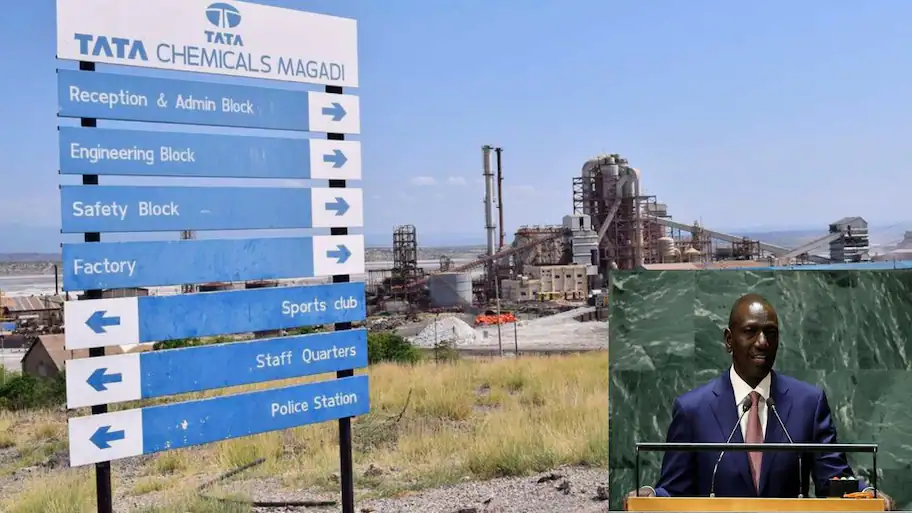
Ruto expressed his disappointment with Tata Chemicals, saying company’s operations “failed to benefit” the African country. Kenyan President William Ruto has directed Tata Chemicals to stop its operation in the country, intensifying a dispute that has been ongoing since July.
Tata Chemicals, however, has said that it is complying with all applicable regulations. The president made the remarks during a visit to Kajiado in southern Kenya, home to Tata Chemicals’ Magadi soda ash operations.
Tata Chemicals’ reply on Presidential order In its latest statement, Tata Chemicals said it acquired the Magadi plant in 2005 and that the business has since made a significant contribution to Kenya’s economy. Ruto said the company had a 100-year contract but had not established a factory in Kajiado. The current crisis began on July 28, when Kenya’s Mining Cabinet Secretary Hassan Joho directed Tata Chemicals Magadi to suspend all mining operations. In an August 17 statement, the company said around 500 employees and their families, along with contractors, suppliers, transporters and local businesses, depend directly or indirectly on the economic activity generated by its operations. It added that around 30,000 people in the Magadi community benefit directly from its support for water, healthcare, education, infrastructure and community development. The company said its Kenyan business exports more than 350,000 tonnes of soda ash annually to markets across Southeast Asia, India, the Middle East and Africa. Tata Chemicals acquired the Magadi business in 2005, although the operation dates back to 1911, when it began as the Magadi Soda Company.
Following the Kenyan President’s remarks, Tata Chemicals issued a statement saying that it had “submitted all the information and documents sought by the Kenyan government”. The Indian company also said it was “compliant with applicable regulations” and was awaiting the government’s review of its response. The company said its Kenyan subsidiary submitted “all the information, reports and documentation” requested by Kenya’s Ministry of Mining, Blue Economy and Maritime Affairs on August 11. Tata Chemicals said it had provided a comprehensive response to the concerns raised by the ministry, including details of its compliance with regulatory requirements. The company has adopted a conciliatory approach, stating that it respects the authority of the Kenyan government and remains committed to “constructive engagement” through legal and regulatory channels to resolve the outstanding issues. Tata Chemicals also said that its priority remains the well-being of its employees, the Magadi community and its stakeholders in Kenya, as well as the country’s continued economic development. “Are we slaves to other people?” he asked. The Kenyan president said his government would bring in two new companies to replace Tata Chemicals. He said one would be expected to set up a large glass manufacturing plant in Kajiado, while the other would produce chemicals locally. Ruto’s government plans to bring in two new companies to take over Tata Chemicals’ operations, according to a Reuters report. The ministry said it had been engaging with Tata Chemicals for years regarding its statutory obligations. It said the company would need to submit documents demonstrating full compliance and settle outstanding liabilities before mining operations could resume. The company subsequently shut down its mining operations and said it would work with the authorities to reach an amicable and speedy resolution.
The dispute, which has been escalating since July, has now intensified from a suspension of mining operations to a presidential directive for the company to leave Kenya. The standoff involves Tata Chemicals Magadi Limited (TCML), which operates the Magadi soda ash business in Kajiado County, Kenya. The company is now awaiting the ministry’s review of the submissions and further directions. Why Kenya President wants Tata Chemicals out? Ruto’s criticism extends beyond the immediate mining dispute. In essence, Kenya wants more than the extraction and export of its natural resources. It wants manufacturing, employment and investment to take place closer to the areas where those resources are found. What actually happened in July? The government cited several unresolved compliance issues, including royalty reconciliation and payments, export reporting, mineral beneficiation and value addition, community development agreements, employment and skills transfer for Kenyan citizens, procurement from local suppliers and environmental compliance. Tata Chemicals, however, maintained that it was fully compliant with the relevant regulations. The suspension also affected soda ash exports from the facility. Tata Chemicals claims thousands benefit from its Magadi operations Tata Chemicals has rejected suggestions that its operations have provided little benefit to Kenya. Tata Chemicals Magadi is one of Africa’s leading natural soda ash producers. Soda ash, or sodium carbonate, is widely used in glassmaking, detergents, chemicals and water treatment. The company produces it from trona, a naturally occurring mineral found at Lake Magadi.
During a visit to Kajiado in southern Kenya on Thursday, the president accused Tata Chemicals of failing to generate sufficient economic value locally despite operating in the region for decades.
