
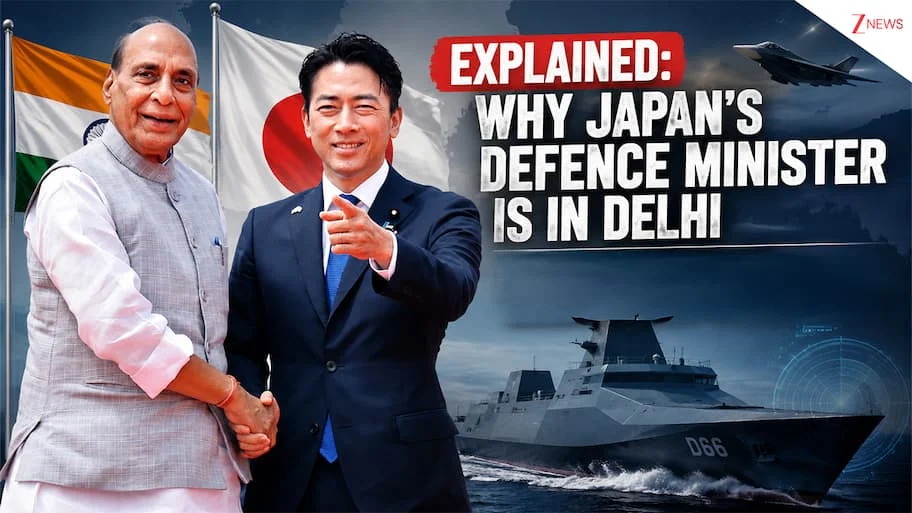
Japan’s Defence Minister Shinjiro Koizumi is in India for his first official visit, with talks in New Delhi focused on strengthening defence ties, maritime security and military-technology cooperation. His visit has also brought attention to the UNICORN naval antenna project, an India–Japan initiative intended to improve the radar-signature management and electronic integration of Indian Navy warships.
In Mumbai, he visited the Western Naval Command, laid a wreath at the Gaurav Stambh and received briefings on Indian Navy operations and capabilities. Koizumi arrived in Mumbai on Wednesday before travelling to New Delhi for talks with Defence Minister Rajnath Singh.
On April 21, 2026, Tokyo revised its Three Principles on Transfer of Defence Equipment and Technology. India and Japan signed a Memorandum of Implementation on November 15, 2024, for the co-development of UNICORN masts for Indian Navy ships. The two defence ministers are discussing strategic trust, maritime-security cooperation and defence-technology ties. Their talks are also expected to examine new areas of collaboration under India’s Make in India policy. Japan is creating greater scope for defence-technology transfers. The revision widened the range of defence equipment and technology that may, in principle, be transferred overseas. Individual transfers remain subject to government approval, case-by-case review and safeguards. India’s Defence Ministry described it as the first planned case of defence-equipment co-development and co-production between the two countries. This describes the intended model and does not confirm that full-scale production or operational deployment has already begun. The project represents an agreed co-development initiative with a planned co-production or Indian-integration dimension. The extent and timing of production, technology transfer and installation remain dependent on relevant agreements and approvals.
