
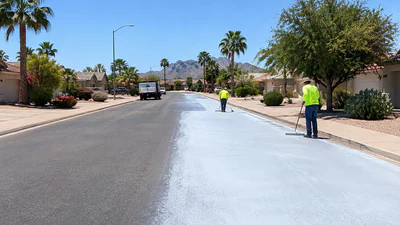
The city’s 2020 Cool Pavement Pilot Program coated sections of residential roads in eight neighborhoods with a lighter, more reflective seal. Phoenix tried a deceptively simple way to fight extreme urban heat: make its streets reflect more sunlight. The goal was to reduce the amount of solar energy absorbed by asphalt and, in turn, lower temperatures across neighborhoods where summer heat can make outdoor surfaces dangerously hot.
In 2020, Phoenix selected portions of eight neighborhoods, one in each City Council district, for the pilot. The initial field campaign covered about 36 miles of residential streets, and the research examined treated and untreated areas across three neighborhoods in detail. But the experiment revealed a less obvious trade-off.
Researchers measured surface, air, and subsurface temperatures, along with mean radiant temperature, which captures the combined radiant heat a person experiences from surrounding surfaces and the sun, according to Arizona State University . The reflective pavement did make the road surface substantially cooler, yet it also sent more solar radiation back toward people nearby. For pedestrians walking directly on the treated pavement, that meant a measurable increase in radiant heat exposure even as the pavement itself cooled. The treatment was applied to streets that were already due for pavement preservation, allowing the city to test the coating without creating a separate road-construction program. The city partnered with researchers from Arizona State University to examine how the treatment affected several aspects of the local environment. The team also monitored how the pavement’s reflectivity changed over time. Researchers used vehicles equipped with temperature sensors, thermal imaging from helicopter flights, and a mobile weather station called MaRTy to measure conditions experienced at pedestrian level.
At noon and in the afternoons, the temperature of the roads with the treatment was 10.5° to 12° cooler than the traditional asphalt. During sunrise, the temperature difference was slightly lower, 2.4° on average. Temperatures of the subsurface also had an average of 4.8° cooler. A 2023 study in Nature Communications found that reflective pavement can substantially reduce surface temperatures, but its effect on human heat exposure is more complicated. The study also found that reflective pavement significantly lowered surface temperatures, while differences in 2-meter air temperature remained small and within the uncertainty of the measuring instruments. Measurements over 10 months showed solar reflectivity falling from roughly 33% to 38% initially to 19% to 30%, although it remained more reflective than untreated asphalt, which had a reflectivity of about 12%. A 2026 study in Building and Environment found that reflective pavement in Phoenix continued to produce cooler surfaces, but increased midday mean radiant temperature, reinforcing the importance of considering pedestrian exposure rather than relying only on pavement temperature.
The temperature difference was due to the pavement’s higher reflectance. From the tests, there was a clear advantage at the surface of the pavement. the lighter substance reflected some of it away While the dark asphalt absorbed most of the solar energy. However, the same quality caused a disadvantage when applied to humans. In Phoenix, researchers found that mean radiant temperature was higher over reflective pavement around noon and during the afternoon, as the lighter surface reflected more solar radiation toward people on the roadway. The effect varied with the time of day and location, with no significant difference detected on adjacent sidewalks. Before sunrise and after sunset, mean radiant temperature was slightly lower over the treated pavement. The findings show that reflective pavement can cool the road surface without necessarily reducing daytime radiant heat exposure for pedestrians. The Phoenix experiment illustrates why reducing pavement temperature is not necessarily the same as reducing heat exposure for people. A road can become cooler while reflecting more sunlight into the space immediately above it. The effect also changed as the coating aged over time. More recent research has continued to examine the trade-off. For Phoenix, the lesson is not necessarily that reflective pavement failed. Instead, the experiment showed that where and how cool pavement is deployed matters.
