
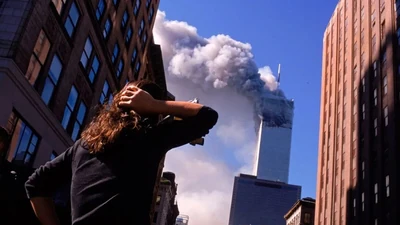
Of all the city’s buildings, the World Trade Centre, erected in 1973, seemed the most muscular. I grew up in downtown Manhattan, with a special reverence for its buildings. My mother was an architectural historian; my dad spent his spare time protecting city landmarks. When I was still small enough, he would perch me on his bike and zip down the city’s avenues while I gazed up at its towers, the way a child in the West might admire the Tetons. I eventually learned the history of New York’s Art Deco ziggurats and Beaux Arts library, and how Mies van der Rohe could make the office towers he designed seem to float. The Chrysler building soars gracefully upward. The Twin Towers were massive vertical blocks—powerful, invulnerable.
The death count in New York, when it finally came, was 2,753. More than 400 first responders were killed, many trapped inside the buildings after racing upstairs to help. It was a deadlier attack than Pearl Harbour in 1941. Covid-19 wielded its earliest, deadliest blow on New York, overwhelming its morgues, and the city again became eerily quiet. In 1911 a deadly fire at the Triangle Shirtwaist Factory killed 146, mostly young immigrant women, unable to find a way out. After Michael Bloomberg became mayor in 2002, he set about working with state politicians, developers, community advocates and cultural leaders to reimagine New York’s downtown. Lower Manhattan’s population in 2024 was more than double what it had been in 2000.
I worried there would be more attacks; I wondered if I knew anyone killed already. When I came home that weekend, eager to be with my family, the city was quiet, plastered with signs seeking information about missing mothers, fathers, children. A few days later, I learned that the sister of my childhood best friend was dead. I’d spent countless hours in her kitchen. She was driven, sharp and fun; I’d admired her since I was five. She had recently graduated from university, landing a job at a top financial firm with offices on the upper floors of the World Trade Centre. Real life was about to begin. It was hard to contemplate how the victims’ families could ever recover, or what New York’s future might hold. So the city grieved, and still does, and it kept marching forward, as it always has. That is the special trait of all great cities, and mine in particular. The attacks of September 11th were by far New York’s worst calamity, but not its only one. The AIDS crisis ravaged the city in the 1980s. There were other types of crises, too. In each instance, recovery was messy, imperfect and real. Larry Kramer founded ACT UP, the AIDS movement’s most influential activist group, after a speech on 13th Street, eventually succeeding in accelerating new treatments that would help patients around the world. The corruption of Tammany Hall and, later, the Triangle Shirtwaist fire, inspired civic leaders, businessmen and labour activists to push good-government reforms and labour protections; New York’s laws would become a national model. It took years to rebuild, with progress often delayed by fights over insurance, design and much else. But the area was eventually reinvented. It now has more housing, more parks, better transport and new centres for art.
In the 1970s crime, debt and mismanagement threatened to unravel New York; a century earlier the city was plagued by political corruption and scandal.
