
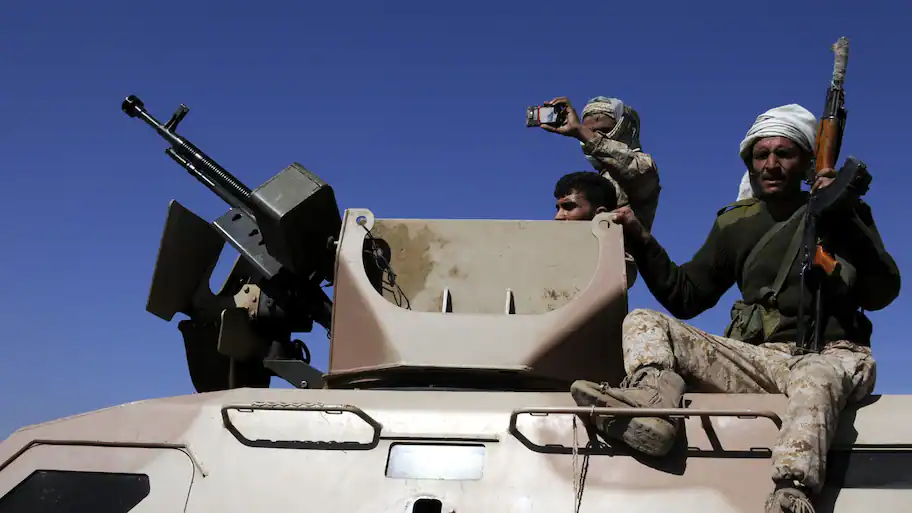
Iran-aligned Houthi forces in Yemen appear to have used Anthropic’s Claude AI to help develop software for guided weapons, including a rocket that was test-fired in Yemen, according to a new threat-intelligence report published by Anthropic.
The company said it identified and disrupted the activity and banned accounts linked to the actors involved. Anthropic did not name the group involved. However, the details of the Yemen-based operation described in the report point to the Houthis, who have developed a significant arsenal of missiles and drones.
Claude used to develop missile guidance software
The second programme involved a multi-stage ballistic missile with a stated range of more than 2,000 km. The company’s September 2026 report covers activity disrupted between December 2025 and August 2026 across several areas, including cyber operations, surveillance, influence operations, biological misuse, conventional weapons and illicit AI-model distillation. The company therefore warned that disrupting their access to Claude did not necessarily end their wider weapons-development efforts.
This meant that no single conversation necessarily revealed the full purpose of their activities.
A weapons engineering cell in northern Yemen was working on three weapons programmes, according to Anthropic. The third, referred to as the “R2000” set, included several missile variants, including one featuring a hypersonic glide vehicle. Anthropic said Claude was used to integrate an open-source autopilot with a phone-class flight computer, write control and position-estimation software, tune control settings, run firmware builds and conduct flight simulations. Anthropic said its safeguards blocked many of the requests, but the actors managed to bypass some of them by concealing their objectives and splitting their work across multiple sessions. The report said the actors made a sustained effort to develop guided weapons and conducted a live test of a guided rocket in Yemen. Within hours of the test, the actors returned to Claude to investigate what had gone wrong, according to the report. Anthropic also said the actors had already developed an offline simulation toolkit that did not depend on Claude or other engineering software environments. The Yemen operation was one of four conventional-weapons cases in which Anthropic said actors used Claude to develop or refine weapons-related software. Anthropic said one China-based actor used Claude to work on an anti-torpedo weapons system, while a Russia-based group used the AI system to develop software for an autonomous military drone swarm. Anthropic said the cases highlighted in the report were not typical examples of misuse, but some of the most notable and sophisticated activity it had identified.
One involved a guided rocket using a commercially available, phone-class flight computer and final-phase homing guidance. The actors used Claude Code to develop guidance, navigation and control software, known as GNC, which helps steer and stabilise a flying vehicle. The operators also ran multiple Claude instances at the same time, assigning different roles to each. One instance was used for coding, another for research and a third to review the work produced by the first. Anthropic does not have evidence that the group successfully fielded an operational guided weapon. However, the test-fired rocket apparently failed. Another China-based actor used Claude to develop targeting software for electronic warfare and air-defence suppression.
The company said it had banned accounts associated with the operations, strengthened its safeguards and shared relevant information with authorities and industry partners. Anthropic said the report was intended to help governments, security researchers and other AI developers understand how such misuse is evolving and improve safeguards against it. The findings underline a growing security concern: increasingly capable AI systems can assist actors not only with information gathering but also with complex technical work related to weapons development.
