
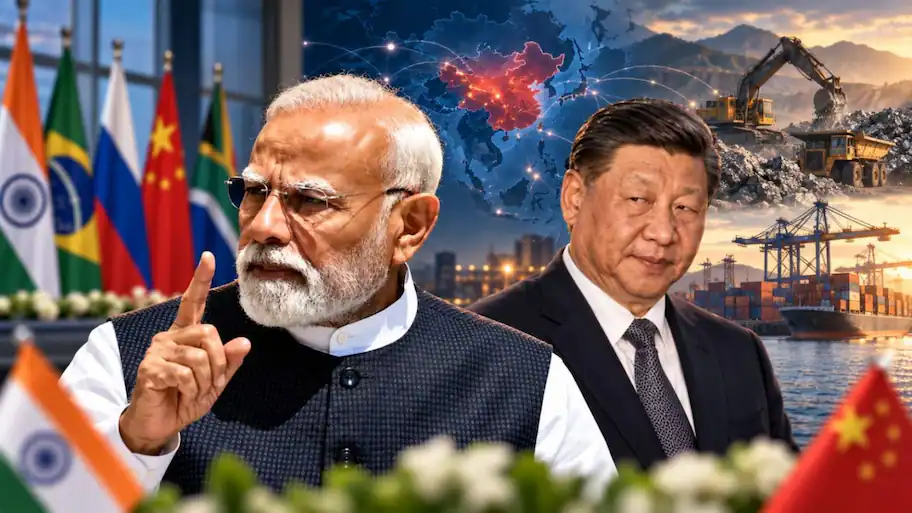
Prime Minister Narendra Modi on Sunday warned at the BRICS Summit 2026 that using technology and critical minerals as tools of pressure could slow global growth. Speaking with Chinese President Xi Jinping present, PM Modi called for wider access to technology and safer supply chains, remarks seen as a clear signal over China’s dominance in rare earth mining and processing markets.
Because it gives them a greater role in discussions on trade, technology and economic policy, the Prime Minister said BRICS has gained support among developing countries. Because they are used in batteries, renewable energy systems, electric vehicles and low-emission technologies, such minerals have become increasingly important.
Addressing a session on Resilience, Innovation, Cooperation and Sustainability, PM Modi said countries must make technology more accessible and reduce risks in critical mineral supply. “The weaponisation of technology and critical minerals could hinder our shared progress; therefore, we have emphasised inclusivity in the adoption of technology,” PM Modi stated. “We may be rooted in different realities, but together we rise through cooperation,” PM Modi said. PM Modi described the declaration as evidence of an expanded BRICS grouping that is “wider in reach and stronger in purpose.”
The remarks came as governments worldwide try to reduce their dependence on a small number of countries for minerals needed for electric vehicles, electronics, renewable energy and defence equipment. “May our diversity remain our identity, our cooperation serve as our inspiration, and our progress benefit all of humanity. PM Modi’s comments followed the adoption of the New Delhi Declaration by BRICS leaders. The declaration called for fair, sustainable and diversified supply chains for critical minerals. The declaration also backed the right of resource-rich countries to manage their own mineral resources and gain more economic value from local processing instead of depending mainly on exports of raw materials.
It accounts for about 70 per cent of global rare earth mining output and more than 90 per cent of refining and separation capacity, according to figures cited on the sector. China has a dominant position in the global rare earth industry. Its position is even stronger in permanent rare earth magnets, which are used in electric vehicle motors, wind turbines, smartphones, aerospace equipment and defence systems.
What weaponising critical minerals means
China has previously introduced export controls covering materials including graphite, gallium and germanium. This means that minerals extracted in countries such as Australia, the United States and Myanmar can still pass through Chinese processing facilities before reaching manufacturers. The dependence has raised concerns that restrictions on mineral exports could disrupt production in several industries. Weaponisation in this context means using control over technology, minerals or processing capacity as political or trade leverage. Restrictions on such materials can affect prices and supplies for manufacturers that depend on them. Access to mineral processing technology has also become part of the debate. China has built a large refining industry over several decades and has placed controls on the transfer of some processing technologies. A prolonged supply disruption could affect industries ranging from electric vehicles and renewable energy to electronics and defence manufacturing. PM Modi used the summit to back new BRICS programmes aimed at improving supply security and sharing technology among member countries. The proposals are aimed largely at developing economies that can be hit hardest when global supply chains break down or commodity prices rise sharply.
With China holding a large share of global rare earth processing capacity, PM Modi’s warning puts access to minerals and technology firmly on the BRICS agenda as member states discuss how to protect their economies from future supply shocks.
