
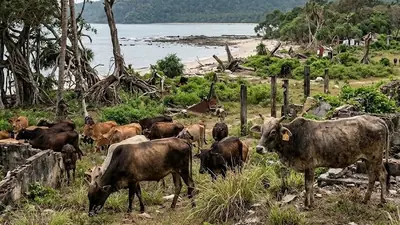
26, 2004, a massive earthquake and tsunami struck the Andaman and Nicobar Islands, devastating Trinket and forcing its human population to leave. For generations, cattle on Trinket Island were part of human life in India’s Nicobar archipelago. Then, on Dec. The cattle were left behind.
What happened after the tsunami?
The 2004 disaster changed the cattle’s relationship with people almost overnight. The same paper reported that only around 150 descendants were then known to exist. Trinket was among the islands severely affected by the tsunami , and the surviving inhabitants were evacuated to neighboring islands. With no human community left to manage the animals, the cattle became completely feral. Unlike conventional cattle, the animals no longer depended on people for regular feeding, breeding management, or veterinary care. They had to find food and shelter themselves, while living within the limits of a small island environment. The population’s precarious condition was documented in The Indian Journal of Animal Sciences . Researchers examined blood-based indicators including hematological values, serum biochemistry, and mineral profiles. The measurements fell within normal physiological ranges and provided baseline data for future health assessments. That number placed the cattle close to the edge of extinction and highlighted the need for conservation measures.
The existence of just about 150 of these animals, as recorded in the 2020 study, is indicative of the rapid rate at which such unique genetic inheritance can be lost. The cattle’s unusual history also prompted researchers to investigate where they came from genetically. Scientists also examined mitochondrial DNA, focusing on the D-loop and cytochrome b regions. The analysis placed Trinket cattle within the Bos indicus lineage and identified them as the I2 sub-haplotype. Researchers suggested that this genetic signature may reflect the historical movement of the I2 lineage toward Southeast Asia. The finding offered a way to distinguish the isolated island population from other cattle and provided information that could be useful for conservation breeding. The Trinket cattle also carry the legacy of a colonial experiment that outlasted its original purpose. Their history reflects shifting human dynamics, transitioning from colonial livestock management to indigenous husbandry to total post-tsunami abandonment.
