
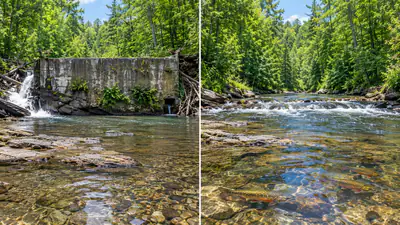
One stood in a river in Colebrook, New Hampshire, for 95 years. According to a January 2025 story from the U.S. Fish and Wildlife Service , the complete removal of the Washburn Mill Dam in October 2024 has restored access to nearly 40 miles of excellent brook trout habitat.
Some old structures just refuse to go away. It’s a big deal for a small fish.
Initial planning began in 2019 when project partners visited the site. The agency’s National Fish Passage Program provided $500,000, supplementing $650,000 secured by American Rivers, which led the project with the New Hampshire Fish and Game Department and the state Department of Environmental Services. Preliminary plans were developed in 2022, and the dam was completely removed in October 2024 despite weather challenges threatening the work.
The New Hampshire Department of Environmental Services Dam Bureau and the Upper Connecticut River Mitigation and Enhancement Fund prioritized removal.
A 2023 study published in the North American Journal of Fisheries Management examined brook trout in the Beebe River watershed in central New Hampshire. However, sampling in 2018 and 2019 revealed no significant genetic changes following a culvert removal project in 2017.
Jaime Masterson, an agency fish biologist involved since the beginning, says this part of the East Coast will be one of the last strongholds for the species as climate change continues. Fish numbers may not rise, since rivers are typically at capacity, but she expects “more genetically diverse fish” that can persist into the future. Colebrook’s cold, clean waters are well suited to brook trout. Slimy sculpin, burbot, wood turtles and other native species should benefit too. Trout in tributaries blocked by impassable culverts were genetically homogeneous and distinct, while those in open tributaries showed a great deal of mixing. The authors propose that prespawning behavior and geomorphological disturbances may have limited immediate genetic mixing, and they emphasize the need for monitoring after restoration. Culverts are not dams, so the comparison is a loose one, but it is a reminder to be patient.
Reconnecting the Connecticut River’s northern tributaries can increase genetic diversity in previously isolated populations.
