
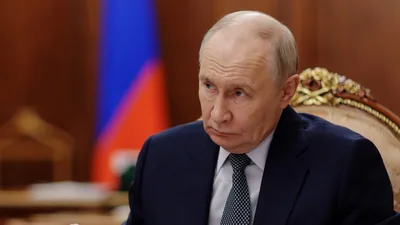
During a meeting on August 29th with staff and students at a Moscow university, Russian President Vladimir Putin made an unusual reference to the natural food chain, stating that orcas feed on polar bears. He emphasized the importance of teaching children about such dynamics, suggesting it helps them understand the complexities of the world. Putin linked this discussion to Russia’s ongoing military actions in Ukraine, which he refers to as a ‘special military operation.’ He implied that understanding these natural relationships is crucial for grasping the rationale behind Russia’s military engagement.
That, the source said, was the president’s interpretation of the visit to Moscow in November 2021 by Bill Burns, Joe Biden’s CIA director, to warn him against invading Ukraine. As for the ground war, Russian sources say Mr Putin is committed to throwing an additional 300,000-400,000 men into the meat grinder.
In an address on August 22nd he accused Ukraine of opening a “Pandora’s box” and promised “blowback on the most sensitive sectors of your economy”. “The special military operation continues,” he vowed. Indeed, a longtime associate of Mr Putin says he is likely to have seen Mr Ratcliffe’s visit as a sign of American weakness. He probably believes that ending the war without achieving even his minimum goal, taking all of Ukraine’s eastern Donbas region, would put him physically at risk. (“They will hang me,” he told some of his cronies at one point during the war, according to an insider.) Within Ukraine, escalation largely means scaling up things Russia is already doing. On August 30th Russia’s ministry of defence said it was preparing a massive strike on Ukraine’s energy infrastructure.
Meanwhile Mr Putin has ended his long silence over Ukraine’s increasingly successful drone attacks on Russian oil refineries and logistics centres, including warehouses belonging to Wildberries, Russia’s largest e-retailer. “We will move only forward. Sources close to the Kremlin say that, after several weeks of consideration over the summer, he seems to have chosen to escalate. He went ahead three months later. Mr Putin may express his aims using the language of geopolitics, but in fact he is guided by the criminal logic of his regime: never show weakness. Russia’s system has a high tolerance for violence, but is unforgiving of failure. But Ukraine already expects such attacks as part of Russia’s all-out offensive to break its will this winter. He does not need to announce a new wave of mobilisation: he never suspended his initial mobilisation order. Extra men will probably be recruited using coercion by regional governments to keep any political discontent localised. The authorities are already testing the new recruitment system in Penza, a region 750km south-east of Moscow.
Earlier that day, speaking to United Russia, the Kremlin’s political party, he dismissed any notion of ending the war.
