
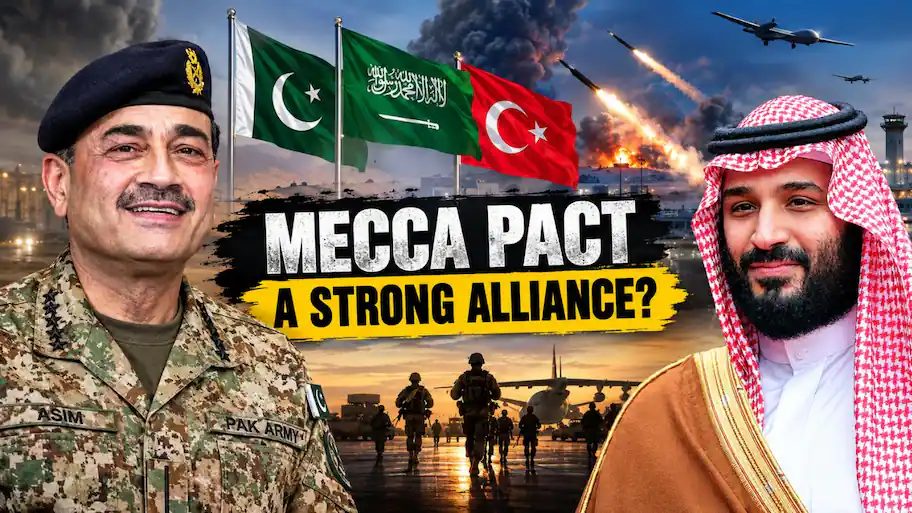
Saudi Arabia’s strategic decision to deploy thousands of Pakistani troops was meant to fortify its borders, yet the immediate aftermath has exposed deep vulnerabilities in Riyadh’s new defence blueprint. The comprehensive analysis examines the inner workings of the newly minted ‘Mecca Pact’, a regional security arrangement bringing together Riyadh, Islamabad, and Ankara under an umbrella widely described as the ‘Islamic NATO’, to answer a critical question: what protection was this coalition truly supposed to provide? In today’s edition of DNA, Zee News Managing Editor Rahul Sinha decodes the sudden Houthi missile and drone strikes that hit key Saudi targets almost immediately after the deployment.
The partnership was officially activated on October 5, 2026, driven by Saudi Arabia’s growing anxiety over the long-standing conflict with the Iran-backed Houthi movement in Yemen. The subsequent chain of events unfolded with striking speed: October 7 deployment: Pakistani troops and heavy military hardware arrived on Saudi soil to reinforce the kingdom’s defences. Strategic breach: The offensive reportedly targeted six Saudi airports and military installations, with two missiles breaching defence perimeters to hit their targets, leaving three people dead and 36 others seriously injured. Reports indicate that Pakistan has sent an estimated 15,000 troops, 10 advanced fighter jets, and Chinese-made air defence systems to secure Saudi airspace.
Watch: #DNAमित्रों | इस्लामिक NATO.. शुरु होते ही खत्म ? पहली परीक्षा में इस्लामिक NATO फेल ! #DNA #DNAWithRahulSinha #IslamicNATO #SaudiArabia @rahulsinhatv https://t.co/lkjTpa6EPc The operational timeline of this security pact has drawn intense global scrutiny due to the rapid escalation of violence. Immediate Houthi counter-strike: Almost immediately after the deployment, Houthi forces launched a coordinated barrage of ballistic missiles, cruise missiles, and suicide drones. the timing reveals a glaring strategic gap While these casualty figures await independent verification. It remains unclear whether the newly arrived Pakistani forces had even become operational or if they were assigned to protect the specific facilities that were hit.
During those decades, Pakistani forces achieved a highly mixed record; while they were exceptionally successful at training local Arab armies and famously cleared the captured Grand Mosque in Mecca in 1979, their presence did not stop wider external wars from destabilising the region, such as the heavy regional conflict triggered by the Iran-Iraq War. This strategic deadlock repeated itself decades later during General Raheel Sharif’s 2017 command, when the former Pakistani Army Chief was hired to lead a Saudi-led military alliance against terror. Therefore, a single successful missile strike cannot prove the alliance has failed; rather, it highlights the need to clarify what the three governments actually agreed to defend. Because the coalition became deeply polarised politically, and Islamabad steadfastly refused to let its troops get dragged directly into foreign ground wars like the active conflict in Yemen, that initiative ultimately failed to create a strong defence shield. Therefore, while past performance cannot be used to directly blame current Pakistani forces for the recent airspace breach, it raises valid questions about their exact operational responsibilities today.
However, a military deployment of this size does not automatically guarantee an impenetrable shield. The effectiveness of these forces depends entirely on where the air defence batteries are positioned, how quickly they can be integrated with existing Saudi networks, and their overall state of readiness. Consequently, critics are sharply questioning Riyadh’s heavy reliance on foreign military assistance at a time when the state is facing direct, active threats from Yemen. The ultimate test for the Mecca Pact lies in its legal and operational framework. ‘ there is no publicly available official text to prove that Saudi Arabia, Pakistan, and Turkey have committed to a binding, collective defence clause Although the media has branded the alliance an ‘Islamic NATO. In international diplomacy, military cooperation often focuses on intelligence sharing, joint training, and logistical support without requiring partners to fight each other’s wars. To fully understand the deep-seated scepticism surrounding Pakistan Military deployment in Saudi Arabia, the DNA analysis traces Islamabad’s historical military footprint in the Middle East. This background reveals a complex legacy that dates back to the 1960s and 1970s. The bottom line of this historical deep-dive is clear: past deployments prove that while Pakistani troops excel at internal security training and guarding specific physical structures, they have never operated as an all-protecting shield against modern, incoming heavy bombardment. Ultimately, the crisis is not just about the Houthi forces successfully launching an attack; it is about whether this ‘Islamic NATO’ possesses the unified command structure and resources necessary to protect the kingdom from modern aerial warfare.
