
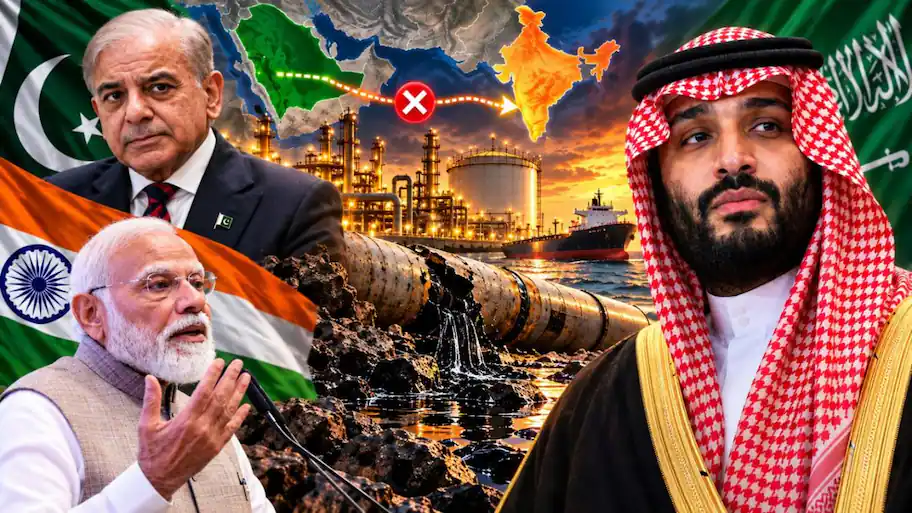
At almost the same time, Pakistan’s military has vowed to go “to any extent” to defend Saudi Arabia. Saudi Aramco has halted normal crude supplies to Indian refiners after an attack damaged the kingdom’s East-West Pipeline. The two developments have raised an obvious question in India, i.e., is there a connection between Riyadh’s oil disruption and Islamabad’s military promise?
The pipeline has been offline since September 10. Saudi Arabia has cancelled some cargoes for European customers, while Poland’s Orlen bought 16 additional crude cargoes to cover the disruption. Saudi Arabia has sold about 60 million barrels of crude for September and October loading from Ras Tanura in the Gulf. Pakistan’s promise comes against the background of the Makkah Joint Defence Agreement signed by Saudi Arabia, Pakistan and Türkiye on August 7. Earlier in 2026, Pakistan also sought Saudi help when disruption around the Strait of Hormuz threatened its energy supplies.
Because crude prices and shipping costs have risen, indian refiners can find replacement barrels, but they may have to pay more. Pakistan’s latest promise therefore signals its willingness to support Riyadh, but it does not confirm that Pakistani troops are about to enter combat. Saudi Aramco has halted its regular crude supplies to Indian refiners until further notice, The Economic Times reported. Pakistan has not announced a new combat troop deployment in response to the latest attacks. Other customers, including European refiners, have also lost or delayed Saudi cargoes.
The oil will be transferred between ships near Sohar in Oman, according to trade sources. Pakistan military spokesman Lieutenant General Ahmed Sharif Chaudhry said Islamabad’s commitment to Saudi Arabia was “unconditional”. “We will go to any extent for the security of the two holy sanctuaries and the kingdom of Saudi Arabia,” he said in an interview with Arab News. Chaudhry also said Pakistan stood with Saudi Arabia “both diplomatically and physically”. The agreement says an armed attack on one of the three countries will be treated as an attack on all three. Pakistan Defence Minister Khawaja Asif has said Islamabad would stand by Saudi Arabia “practically and diplomatically” if the conflict with the Houthis worsens. Asif said the agreement would come into effect if the territorial integrity of a member country was threatened. Asked about the current situation, he said, “The situation has arrived. Pakistan’s Foreign Office said earlier this month that some Pakistani forces were already in Saudi Arabia for training and logistical work under existing bilateral defence cooperation. Pakistan’s petroleum ministry said at the time that Saudi officials had assured it of support and that Islamabad hoped oil supplies through Yanbu would be prioritised for Pakistan.
Saudi Arabia’s oil network has come under pressure after attacks damaged its East-West Pipeline, which moves crude from the kingdom’s eastern oil fields to the Red Sea coast. The disruption affected operations at Yanbu, an export hub that had become more important as Gulf producers struggled with problems around the Strait of Hormuz. The impact is not limited to India. No. The disruption affects Aramco’s normal supply arrangements, but Saudi oil is still expected to reach India through other routes. China and South Korea are among the main buyers, while some of the oil is also expected to go to India and Japan. Aramco has also sold spot cargoes that could reach Indian refiners. This means India faces a supply and cost problem rather than a complete Saudi oil cutoff. As Riyadh deals with attacks on its territory and energy infrastructure, Pakistan has made a much stronger statement about Saudi security. The statement came as Saudi Arabia faced attacks linked to the conflict with Yemen’s Houthis. It also calls for closer military cooperation. It also cautioned against treating the new Makkah pact as a fully established operational military structure. The agreement still needs mechanisms and frameworks to put some of its provisions into practice. This is where the timing may attract attention, but the available evidence does not show that Saudi Arabia stopped contractual supplies to India in order to divert that oil to Pakistan. Saudi Arabia and Pakistan do have a long-standing energy relationship. Those arrangements pre-date the latest shutdown affecting Indian refiners. There is no public evidence of a direct trade-off. India’s supply problem can be traced to physical damage to Saudi oil infrastructure and the resulting disruption at Yanbu. Pakistan’s military promise comes from a separate defence relationship that has grown closer through the Makkah agreement and is now being tested by attacks on Saudi Arabia. The two stories meet at one point, i.e., Saudi Arabia is trying to protect its territory and keep its oil moving at the same time. For India, the immediate concern is how much replacement crude will cost and how reliably it can reach Indian refineries. For Pakistan, the unanswered question is how far Islamabad is prepared to go if Riyadh asks for military support under the new defence pact.
Riyadh has previously helped Islamabad through deferred-payment oil facilities, and the two countries discussed further energy cooperation in July.
