
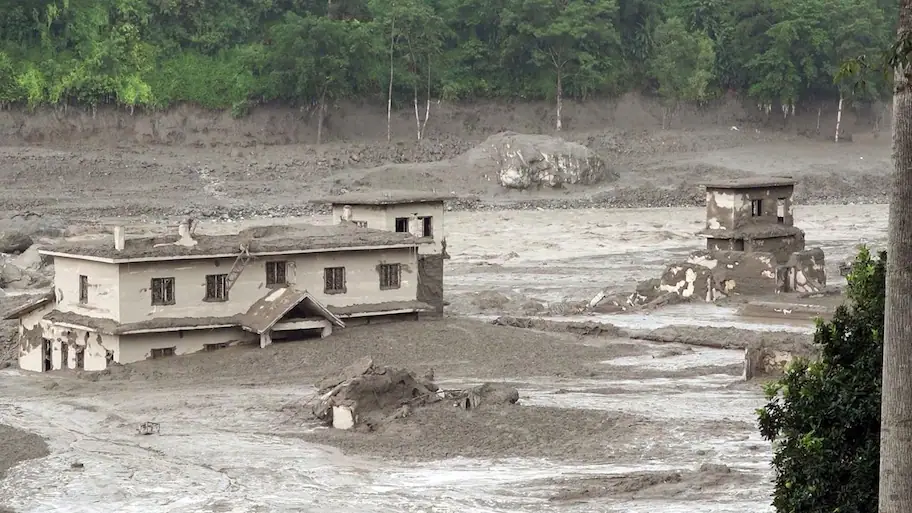
New Delhi: China has imposed tight controls on reports and videos emerging from Tibet after a major flash flood hit areas along the Tibet-Nepal border, with several videos showing the scale of the destruction disappearing from social media.
Khedrub Thondup, the nephew of the Dalai Lama, wrote in the European Times that a large section of a glacier on Mount Langtang Lirung broke away and fell more than 2 km into the valley. He said the collapse generated seismic energy equivalent to a magnitude 5.2 earthquake, sending a sudden surge of water towards villages along the Tibet-Nepal border.
He said information in Tibet about the disaster has been limited. He alleged that China’s censorship has prevented official bulletins and local reports from emerging, while information shared online can be removed or labelled as a rumour.
Human rights groups have also reported restrictions on Tibetan monks, nuns and ordinary residents.
The Chinese Communist Party views Tibet through the lens of stability and national security, according to him. The article said while families in Nepal are mourning after the floods, people on the Tibetan side are struggling to obtain information about relatives and villages. Ryan Fieoreci, executive director of the International Campaign for Tibet, said the restrictions also apply during disasters. Information coming from Tibet is controlled by the Chinese government, leaving local residents afraid to share details about where people are trapped or which areas have suffered the worst damage, according to him.
A major natural disaster can damage the image of control and preparedness that Beijing seeks to project. He also mentioned China’s large hydropower and infrastructure projects in the Himalayan region, arguing that a glacier collapse could expose the risks surrounding such projects. It also argued that the absence of reliable information makes it difficult to coordinate relief operations and determine where the damage is worst. China has exercised control over Tibet since the 1950s, and the region is among the most closely monitored parts of the country. Access for foreign journalists is restricted, with visits generally limited to government-organised trips. People can face detention or arrest for speaking to journalists or posting online material that contradicts the government’s version of events.
