
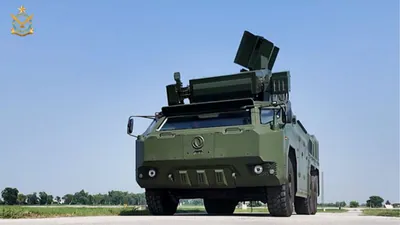
On Monday, Pakistan unveiled a new air defence system that appears to closely resemble China’s HQ-17A short-range surface-to-air missile system. While the Pakistani military has yet to officially identify the missile, the similarities highlight the increasing defense collaboration between Beijing and Islamabad. This development underscores the strategic partnership that has been evolving between the two nations in recent years.
The Chinese system is manufactured by China Aerospace Science and Industry Corporation and was first displayed at the National Day military parade in 2019. As per the International Institute for Strategic Studies, China’s People’s Liberation Army has an estimated 200 HQ-17 and 50 HQ-17A systems. Ties between Pakistan and China, especially in defence cooperation, deepened after the 2025 conflict with India.
As per a report by Bloomberg , a six-wheeled military vehicle with a large rectangular radar array was showcased in a promotional video posted on the official X account of the Pakistani military. The features of the vehicles, as per the report, were similar to China’s HQ-17A short-range surface-to-air missile system. with the HQ-17AE, which is an export variant based on the HQ-17A, Pakistan’s acquisition of the system would mark the first sale in South Asia While China’s system has been acquired by countries such as Serbia and Tajikistan. During Operation Sindoor, Pakistan used Chinese-made J-10C fighter jets during the conflict. Pakistan also claimed that the jets downed multiple Indian aircraft, including French-made Rafales, which New Delhi has denied. The Indian air force stated it destroyed about a dozen Pakistani aircraft during the confrontation, including at least five advanced fighters, such as US-made F-16s or Chinese-made JF-17s jets. The exact number of aircraft destroyed remains disputed, with analysts questioning claims of military success by both sides.
