
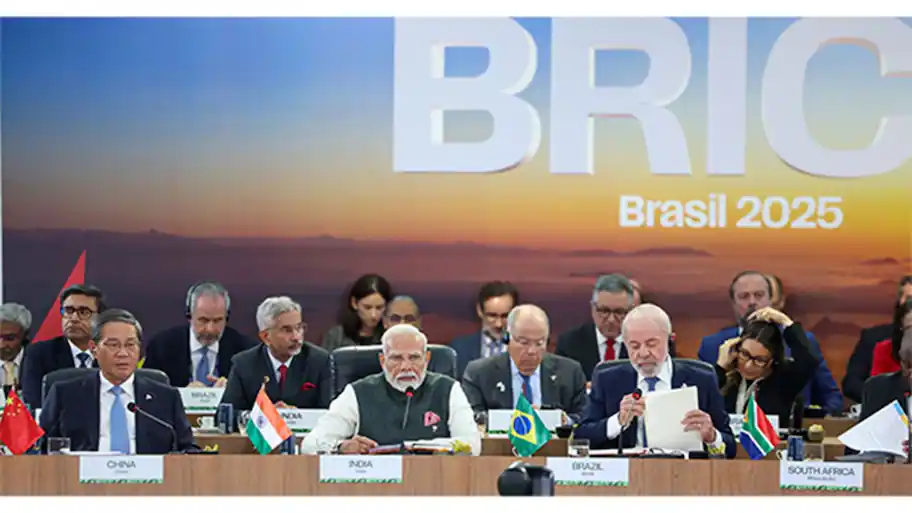
As India prepares to host the 18th BRICS Summit in New Delhi on September 12-13, 2026, New Delhi is navigating a complex balancing act. Having assumed the rotating chairmanship on January 1, 2026, India is steering an expanded 11-member grouping under the theme “Building for Resilience, Innovation, Cooperation and Sustainability.
This redefines the BRICS acronym itself and emphasises a “Humanity First” and people-centric approach focused on practical outcomes for the Global South rather than geopolitical confrontation.
Full members now include the original five, Brazil, Russia, India, China and South Africa, plus Egypt, Ethiopia, Iran and the United Arab Emirates (joined in 2024) and Indonesia (2025).
India has consistently framed BRICS as “non-Western” rather than “anti-Western. The summit comes two decades after the group’s informal origins and follows significant expansion. Partner countries further broaden engagement. The bloc represents a substantial share of global population and economic output on purchasing-power parity terms, amplifying its potential voice in global affairs. Russian President Vladimir Putin and Chinese President Xi Jinping are expected to attend, raising the stakes for bilateral side meetings amid India’s ongoing efforts to stabilise ties with Beijing. External Affairs Minister S. Jaishankar and other officials stress that the grouping should complement the existing multilateral system, not replace it or serve as a platform for confrontation with the West. New Delhi prioritises reformed multilateralism: stronger representation for emerging economies in the United Nations Security Council, IMF quota reforms, and capital expansion for the New Development Bank (NDB) to support sustainable infrastructure without onerous conditions. Recent special representatives’ talks on the boundary issue have produced limited progress that could facilitate smoother summit dynamics, but the unresolved border dispute continues to cast a shadow. India aims to engage Beijing on equal institutional footing within BRICS while promoting its Digital Public Infrastructure model, Aadhaar, UPI and related open-source systems, as a scalable tool for inclusive development that other members can adopt. From Russia, India seeks continuity in energy cooperation and bilateral trade increasingly settled in national currencies, alongside support for development-oriented outcomes. Moscow views BRICS as a key avenue to mitigate Western sanctions and promote multipolarity; New Delhi values the partnership for energy security and defence ties but insists the group remain focused on resilience in supply chains, food and energy security, health, disaster risk reduction, and technological collaboration in areas such as artificial intelligence governance, fintech and space economy.
