
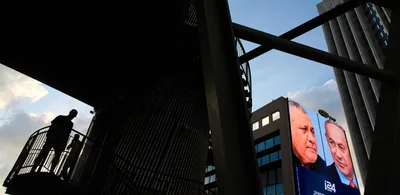
THE FIRST meeting in a decade between an Israeli prime minister and the Palestinian president was a historic scene. The smiles looked real. But the encounter was not. For now, Gadi Eisenkot is merely the front-runner in Israel’s election, not the country’s prime minister. And he has yet to actually meet Mahmoud Abbas, the Palestinians’ ageing ruler.
“Mr Netanyahu and his allies have been investing in election tech for years and have highly developed databases, and the parties of his bloc share voter information,” says one tech industry insider. The realistic-looking footage of the faux-summit was produced by Religious Zionism, a hard-right party led by Bezalel Smotrich, Israel’s finance minister and an ally of Binyamin Netanyahu, its prime minister. It was aimed at convincing voters that Mr Eisenkot, a tough ex-general hoping to replace Mr Netanyahu in Israel’s parliamentary election on October 27th, is actually a dangerous left-winger prepared to reconcile with Israel’s enemies. Mr Netanyahu’s coalition of ultra-nationalist and religious parties is lagging in the polls. But the prime minister has one key advantage: his partners are united behind him. Over the past three years the Israeli government has invested vast sums in online psychological warfare, using AI tools to try to influence audiences in the Middle East and public opinion in the West. Some are now being used domestically.
“Most tech professionals support the opposition and feel they’re fighting for their future in Israel,” continues the insider. Mr Eisenkot’s party, Yashar, was founded just a year ago, and the opposition more generally remains divided. Yet those hoping to replace Mr Netanyahu have the support of a network of anti-government protest groups that are deeply rooted in Israel’s tech community. “We’re going to see them fighting fire with fire. It is not clear whose job it is to stop any of this. The internal security service, the Shin Bet, appears to be willing only to try and prevent foreign meddling, though its mandate is a broad one of protecting Israel’s fragile democracy. Nor does the National Cyber Directorate in the prime minister’s office seem prepared to get involved. That leaves the police, with its limited resources, and the CEC, with its few powers, to patrol this wild new frontier. Government officials and privacy activists claim that the tech companies have so far been quick to deal with issues they flag. But doing so on election day itself, in time to prevent any false reports or manipulation from affecting voting, will be harder. Much of the information being illicitly collected is for get-out-the-vote operations on election day, which is a public holiday. Knowing who their voters might be and what they might be doing on their day off is a key advantage for political parties. Knowing who isn’t likely to vote for them can also be useful; such voters can be sent offers for shops or entertainment venues far from their polling station, or fake news about disturbances in their area.
