
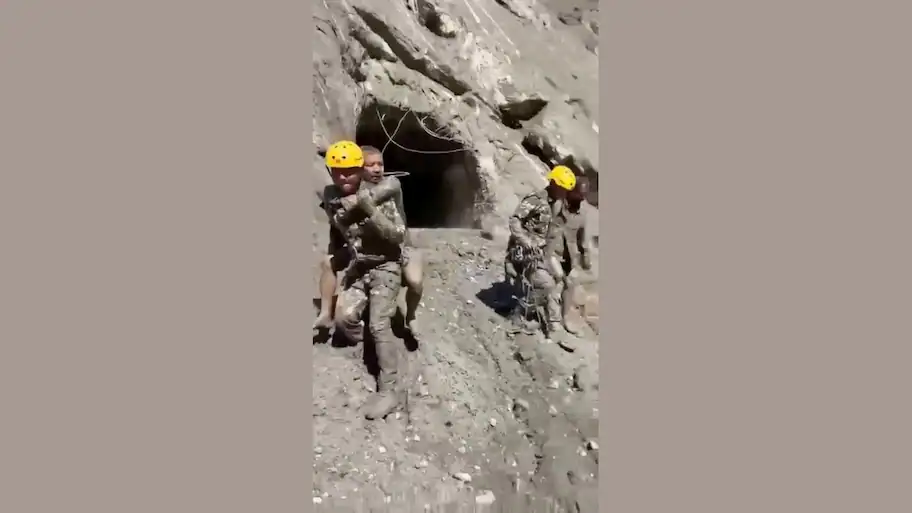
New Delhi: Nepal is carrying out a massive rescue operation after devastating floods killed more than 900 people and left nearly 4,000 missing across the country. Among the most difficult searches are taking place deep inside hydropower tunnels, where hundreds of workers are feared to be trapped.
Officials estimate that around 933 people could be inside tunnels at different hydropower projects. Rescue teams are working at the Upper Trishuli-1, Trishuli 3A and Trishuli 3B projects, where floodwater and debris have blocked access to several sites. Upper Trishuli-1 is the highest hydropower project on the river and was still under construction when the floods struck. On Sunday (August 30), rescuers created a large opening to enter one at the Trishuli 3A project site. The search is now being carried out at tunnels across around 13 hydropower projects. At around 2am on Monday (August 21), a controlled blast was carried out at the Trishuli 3A hydropower project in Rasuwa in an effort to open the route to the site.
Nepal’s Prime Minister Balendra Shah said rescuers called out several times after entering the tunnel, but received no response from inside. The hydropower projects are a major source of electricity for Nepal, and some of their tunnels are connected. Trishuli 3B uses water coming from the 3A project. Rescue teams have been trying several methods to reach workers believed to be inside the tunnels. Authorities have started using controlled explosions in the mountains to clear blocked routes and create access points. More rain is forecast in northern Nepal over the coming days. The weather is making rescue operations more difficult. Floodwater, landslides and unstable mountain terrain have made access to the project sites more difficult. Several soldiers entered a tunnel at the Rasuwa Gadhi hydropower project but found no workers there. Drones were also used to search inside the tunnel.
Priya Kharel has been searching for her brother Milan Kharel, an engineer at the Upper Trishuli-1 hydropower project. At least 897 people working on hydropower projects, including Pandey’s husband Jiblal Adhikari, are still missing, according to the Nepal Electricity Authority and the Independent Power Producers’ Association. With normal roads to the towns cut off, he and his companions spent around 12 hours travelling through the forest before spending the night in a cave. The National Disaster Risk Reduction and Management Authority said 279 people have been rescued from tunnels. At the Upper Trishuli-1 hydropower project, civil engineer Sandeep Rana escaped with around 100 other workers by climbing a nearby hill as floodwater rose. The workers had not even reached their designated assembly point when they were told that a severe flood had hit the dam site around 12 kilometres upstream. The group began climbing towards higher ground and eventually reached a location around 30 to 35 metres above the Trishuli River.
Because there is an oxygen system inside, “I still have 50% hope that he is alive. Because every second counts for us, this operation should move very fast.
The Nepal government has said it needs technical assistance, particularly for tunnel rescue work and the DNA identification of bodies. She said people who had returned from the area told her that workers are still inside the tunnel. “Those who have returned said there are people in the tunnel. So I hope that if the army finds them soon, they can be rescued,” she said. She said the family had been unable to find her brother’s name on any official list. “We tried looking at the lists of missing, rescued and dead people, but his name was nowhere,” she added. His wife, Sita Pandey, told Nepali newspaper Kantipur that she still believes he could be alive. But with every hour, that hope is fading,” she said. Some relatives of missing workers have said the effort should have begun earlier. Relatives of Khadka, who is also believed to be trapped inside a plant, told Kantipur that the rescue operation needs to move faster. This is a very slow operation,” they said. Shiva Giri and six other workers at the Mailung hydropower project had no option but to move uphill when the flood hit, according to PTI. Giri, a technical worker at the project, told Nepal News that several of his colleagues were swept away, including his cousin. There was no time to stop and think,” he told the newspaper. He and his five colleagues were several hundred metres from the tunnel exit when water began rushing inside, according to news website Ratopati. Ramchandra said the six men used a sheet of tin to hold on and moved from one ladder to another for nearly six hours. “We were six people and later we found another person at the tunnel entrance,” he said.
Rescue teams from India, China and South Korea have arrived in Nepal to assist with the tunnel operations. Another family is waiting for news about a man believed to be trapped inside a hydropower tunnel at the Trishuli 3A site. Rescuers began pumping air into the tunnels over the weekend. “The longer it takes, the less our hope will be. Some hydropower workers managed to escape the flooding by climbing into the surrounding hills. They watched homes, settlements and other structures disappear under the water as they fled from the project in Rasuwa towards higher ground. The following morning, Giri’s group descended towards the project site, registered themselves as displaced people and appealed for help. A Nepal Army helicopter eventually took them to Kathmandu, where Giri is receiving treatment at Tribhuvan University Teaching Hospital. From there, they watched the project office, camps and roads disappear beneath the floodwater. “We had to keep climbing while also avoiding falling rocks. The group climbed for seven to eight hours and reached a road in the Grang area at around 4pm. By the time Rana reached Kalikasthan, only two other people were still with him. The rest were separated along the way. Another survivor, identified as Ramchandra, spent the flood inside a tunnel along the Trishuli River. They grabbed an iron ladder fixed along the tunnel roof to stop themselves from being swept away.
He told The Rising Nepal on Monday that an emergency siren sounded while he was in the project office.
