
25 points are available on a Sunday whether the paddock is in Melbourne, Monaco or Monza. Formula One likes to tell itself that every race counts the same. Yet some weekends carry a significance that stretches beyond the numbers on the championship table. They trends, alter narratives and force teams to rethink what they thought they knew.
Key Factors
The 2026 Barcelona-Catalunya Grand Prix may have proved to be one such weekend. Kimi Antonelli’s remarkable rise had become the story of the championship, the 19-year-old building a commanding lead at the top of the standings. George Russell had provided consistent support, and Mercedes had set the pace from the start of Formula One’s sweeping 2026 regulations. At 41, Hamilton became the oldest winner of a Grand Prix since Jack Brabham in 1970 and he reached that milestone a full 19 years after his first F1 win, for McLaren in 2007. If the 2026 championship develops into the multi-team fight many had hoped for, Barcelona may be remembered as the place where everything changed. I think that’s going to restore some of his confidence,” the 1996 F1 champion added. Hamilton didn’t give up without a fight, bringing back memories of his fierce battles with Verstappen in 2021. But in the first three years, the 28-year-old did have the opportunity to go toe-to-toe with the sport’s most successful driver in Hamilton. In 2024, Russell out-qualified Hamilton 19-5, underlining his searing pace. After Hamilton joined Ferrari in 2025, Russell became the natural team leader. Andrea Kimi Antonelli, who joined Mercedes last year, is viewed as a generational talent by team boss Toto Wolff, who backed the Italian to step into Hamilton’s shoes at 18.
Sunday’s win showed off Russell’s smart approach to racing in a different way as he managed his pace and stayed out of trouble, even as those behind him lost time battling each other for position. Both Cadillac drivers retired early, with the team’s crew rushing to put out a small fire on Valtteri Bottas’ car before Sergio Perez reported smoke. So when Mercedes hit the ground running this season under F1’s new rules, which introduced a novel engine concept with increased electrification, the expectation was that Russell would lead the team’s title charge.
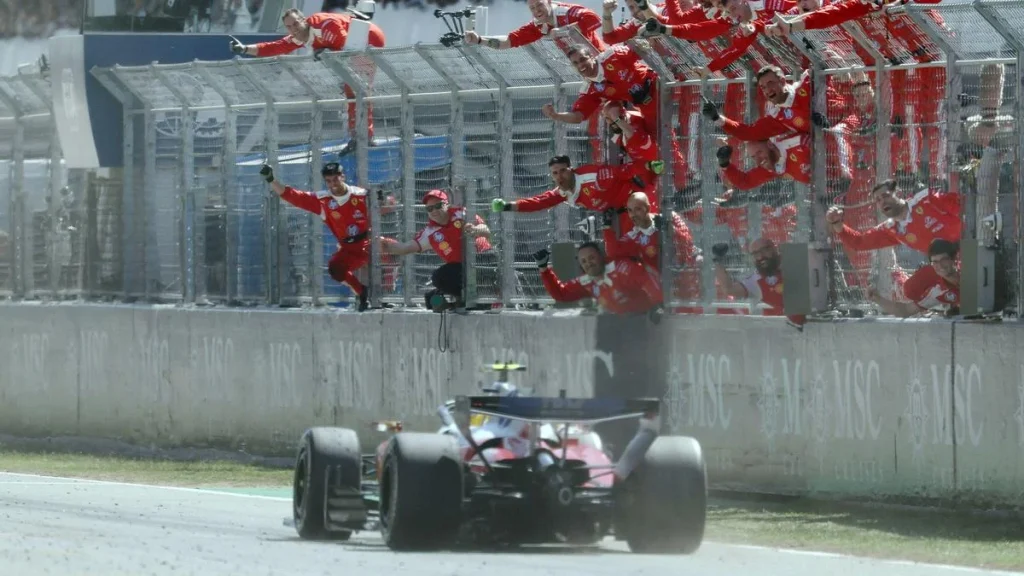
Because it was, as he said at one point, he didn’t know what to say, “George having got a win and closed the gap to Kimi, that’s going to be a positive for him and a massive relief. When Lewis Hamilton crossed the finish line to secure his first victory as a Ferrari driver, the result was significant enough on its own. The seven-time World Champion claimed the 106th victory of his career and handed Ferrari its first win of the season. More importantly, however, the race may have marked the point at which Formula One’s competitive landscape began to shift. For much of the opening phase of the season, Mercedes appeared untouchable. The championship seemed to be developing a familiar rhythm. Mercedes set the pace. The rest chased. Barcelona changed that. Hamilton’s victory reduced the gap at the top of the standings and reminded the paddock that experience remains one of Formula One’s most valuable assets. The achievement was not simply a statistic. It was evidence that a driver many believed was entering the twilight of his career remains capable of shaping a championship. The emotional weight of the victory was impossible to ignore. Ferrari is not the only team encouraged by Barcelona. McLaren continues to linger within striking distance. Lando Norris inherited the final podium spot after Antonelli’s late retirement. The reigning World Champion may not yet possess the fastest package on a given Sunday, but Formula One history is full of title fights transformed by sustained pressure rather than outright superiority. Formula One has a habit of overturning conclusions just when certainty appears within reach. Yet, some races resonate long after the podium celebrations end. They become reference points, moments that historians revisit when explaining how a season evolved. The standings tell us that Mercedes remains in front. The atmosphere after Catalunya suggests the chase has truly begun. He was at a loss for words given the amount of bad luck he had, but he finally got a good victory; a genuine win, he got pole position and so forth. “When a driver is in a team, they can’t consider that they are the primary concern of that team. The problem with being a racing driver in our sport is that you’re not really part of the team. For the time you’re there, you’re part of the team, but you still have to prove yourself against the other guy. So you’re in a constant battle to establish your position”. Racing in a heatwave with a broken drinks system, Russell held off Max Verstappen and his own teammate Kimi Antonelli to turn his controversial pole position into a dominant win. Verstappen took the fight to Mercedes with his upgraded Red Bull car at the team’s home race, but couldn’t get close enough for a shot at Russell and finished up on the defensive against Antonelli. The top three were separated by just two seconds at the finish. Hamilton and the Dutch driver fought side by side in the early part of the race and Verstappen complained Hamilton had forced him wide into a gravel trap. Overheating brakes were a hot topic, with Antonelli among those struggling to stop the car. It was here that Russell proved his worth as a potential champion, getting the better of his illustrious teammate in two out of their three seasons together. And it appeared everything was falling into place for Russell after the first race in Melbourne, which he dominated from pole. In his rookie season, though, Antonelli had a baptism of fire in a tricky car and was comprehensively beaten. Russell would have fancied his chances in a championship-winning car this season even as the teenager — highly rated as he may be — found his footing in the big league. Things started going downhill for Russell in the second race in China where a technical issue compromised his qualifying. Though he recovered to qualify second, he got mugged at the start by the Ferraris and had to fight his way back to second, allowing his colleague to take his maiden win. In Japan, a Safety Car intervention led to him being jumped by Antonelli.
It was his second podium of the season, coming after he had failed to score points at the previous two Grands Prix, on a weekend where McLaren looked more competitive than it had in those earlier rounds. However, since then, things haven’t gone to plan for the Briton, who has seen a challenge emerge from the other side of his garage.
Outlook
Instead, he produced a brilliant final lap to fall just 0.064 seconds short of Russell’s pole position, securing his highest grid position since joining Ferrari and his first front-row start for the team. He had fallen 68 points behind his Mercedes teammate in the standings after failing to score points in the two Grands Prix before Barcelona, and needed a big weekend. The team pitted Hamilton early to undercut Russell, then again on Lap 28 to undercut him a second time, with Mercedes choosing not to cover the move. He went on to win by close to 20 seconds. Antonelli’s retirement, with four laps remaining and an apparent power unit issue, denied the championship leader what would have been a podium finish and cut his points advantage over Hamilton to 41.
Russell’s own pole lap carried its own context. He duly delivered one, producing a superb final lap to outpace Antonelli by around three tenths of a second and claim pole. It would prove to be his last clean shot at victory all weekend. Barcelona provided the clearest confirmation yet that Ferrari’s underlying pace was strong. Hamilton’s victory was not the product of luck alone. Ferrari’s strategy was bold, but the pace underneath it was genuine. Hamilton then built his advantage on fresher tyres before a Virtual Safety Car, triggered by Fernando Alonso’s retirement, allowed him to take his final stop with minimal time loss and emerge in the lead with fresher rubber than the Mercedes cars behind him. The result was a victory built on speed, race-long tyre management, and a fair amount of fortunate timing. The significance extends beyond a single win. For the first time this season, Mercedes looked vulnerable. Mechanical failures are part of Formula One, but their timing can often shape a season. Until Barcelona, Antonelli’s campaign had carried an air of inevitability. Instead, Barcelona reintroduced uncertainty.
Hamilton himself admitted he was “really surprised” by the result, saying he genuinely hadn’t expected to be fighting for the front row.
