
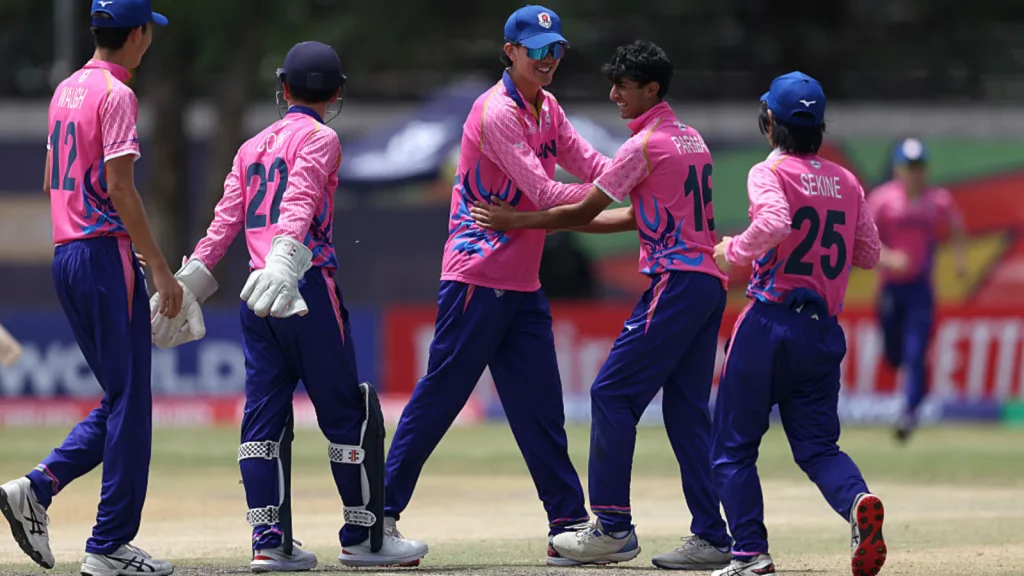
Japan captain Kendel Kadowaki-Fleming and teenaged all-rounder Charlie Hara-Hinze believe the country’s historic one-off T20 against India can be far more than a landmark occasion, with the September 22 fixture potentially providing a springboard for sustained growth of cricket in a baseball loving country. India will travel to Japan for the first ever men’s international between the two countries, with the match at the Sano International Cricket Ground coming just days before Asian Games in Aichi-Nagoya.
And I think a massive development for cricket in Japan to have countries like Afghanistan and Nepal coming here is something that we probably would have thought was very difficult to manage even a couple of years ago,” he told PTI Videos in an interview. For Kadowaki-Fleming, hosting India, along with Afghanistan and Nepal at the Asian Games, shows how far Japanese cricket has progressed in a short period. “It’s very exciting. the Japan captain insists his side does not want to merely celebrate it While the occasion will be historic.
“Exciting, But We’re Not There To Celebrate”: Japan Set Tone For Historic T20I Against India
“I think playing for Japan has definitely put more of a focus on my Japanese heritage,” Hara-Hinze said. (Except for the headline, this story has not been edited by NDTV staff and is published from a syndicated feed.) This year’s Asian Games will be particularly special, with his uncle and grandmother set to watch him represent Japan on home soil for the first time.
Hara-Hinze, 17, is familiar India’s young talent. Japan faced India in the group stage of the 2024 U19 Asia Cup, when the Indian side had IPL-bound youngsters Ayush Mhatre and Vaibhav Sooryavanshi. “I can’t see a reason why in 20, 30 years we can’t be like Nepal or Afghanistan. After making his Japan debut in 2022, representing the country has given him a bond with Japan that extends beyond the sport.
“So it’s just going to be great to be able to watch world-class players and the best team in the world in that format go about it,” he said. “Hopefully this is the first step in a long history of playing against and competing against full member countries,” Kadowaki-Fleming said. You had very little margin for error as well,” Hara-Hinze said. “The Indian cricket team was to come to Japan to face us was something that doesn’t sound real to many people and still probably hasn’t quite sunk in,” he said. “We’re obviously a long way from producing cricket’s version of Shohei Ohtani, but someone has to be the first, right?” he said. “Even if a small amount of the kids that are watching cricket on TV during that time then want to go and pick up a cricket bat or sign up with a cricket club in Japan and play for the first time, then I feel like that’s a success in itself,” Kadowaki-Fleming said. Hara-Hinze said cricket continues to struggle for access to grounds, equipment and coaching, particularly in major population centres such as Tokyo and Osaka. Some players living around Tokyo, he said, travel around three-and-a-half hours by train to Sano simply to attend a net session. “Cricket, it is growing, but at a very slow rate,” Hara-Hinze said, adding that more facilities and sponsors would help accelerate its development. I think there’s definitely a potential for a very large cricketing market in Japan,” he said. Hara-Hinze believes the India match must be “a starting point” for Japanese cricket rather than a one-off spectacle. “The challenge for us is just making sure that it’s not a one-off great day and a great competition, but it leaves a lasting legacy of cricket in Japan,” said Kadowki-Fleming. Kadowaki-Fleming lived in Japan until around six and said his connection to the country began long before cricket entered his life.
“As exciting as the occasion will be of playing India, we’re not there to just celebrate the occasion. We’re there to show what we can do as a men’s team. Obviously, a team like India have all bases covered, whether it’s fast bowling, batting or spin. For Japan, the fixture is about much more than testing themselves against India’s stars. “That was a game we definitely went into with a lot of excitement. We got a lot out of it in terms of bowling to these guys, seeing first-hand how good they are and the standard at which they played. That experience has only heightened his anticipation of facing India’s senior side. The India fixture and the Asian Games could also provide cricket with an opportunity to break into a sporting market dominated by baseball. Kadowaki-Fleming sees significant crossover between the two sports, pointing to hand-eye coordination as well as the emphasis on skill, repetition, discipline and teamwork. Some members of Japan’s national squad have already played baseball or softball as children, while a few baseball players have switched to cricket. But establishing the sport remains a challenge. Japan’s dense geography and high demand for land make establishing cricket facilities difficult, with existing sporting infrastructure dominated by football and baseball. He nevertheless sees enormous long-term potential. The occasion also carries personal significance for both players, who were born in Japan before moving to Australia. Hara-Hinze has similarly found himself reconnecting with his Japanese heritage through cricket. After not returning to Japan for four years during the pandemic, he now visits multiple times a year, reconnecting with his family, culture and language.
