
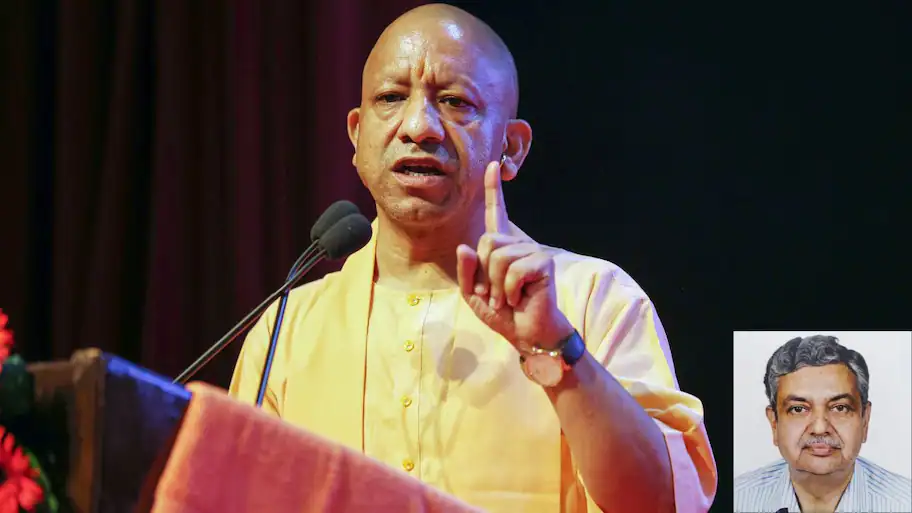
By Anurag Agarwal
With entrepreneurs from all 75 districts attending the trade show under the ODOC umbrella, the state’s economic geography is being rewritten. The Uttar Pradesh Skill Development Mission pavilion featured live demonstrations of 16 skills. The 31% increase in meetings itself indicates that the wheel is turning in the right direction.
The five-day Uttar Pradesh International Trade Show (UPITS), held at India Expo Center and Mart in Greater Noida, has concluded. The stalls have been dismantled, and buyers and sellers have returned to their respective destinations. The impact of the grandeur with which the Yogi government of Uttar Pradesh organised the event and the enthusiasm with which entrepreneurs and buyers participated will be visible in the days to come. As a representative of the Indian Industries Association (IIA), I have no hesitation in saying that UPITS has taken a giant leap in the global market, and we now stand at a significant milestone in the economic landscape. The roots of this achievement lie in the Yogi government’s well-considered policy vision. Over the past few years, state has not confined its economy merely to agriculture and traditional industries. The expanding network of expressways, industrial corridors, the emergence of electronics and information technology in Noida-Greater Noida, and plans for logistics parks and an airport at Jewar all point in the same direction. This points to a state that wants to play a leading role in production, exports, and investment. Policy coordination between the centre and the state, commonly referred to as the ‘double-engine’ government, has given momentum to this journey. The soul of this fair is the concept of ‘One District, One Product’ (ODOP), which is among the Yogi government’s most distinctive economic initiatives. Behind it lies a simple yet profound understanding: every district has a unique skill, and it should receive recognition, a brand, and a market. Whether it is Bhadohi’s carpets or Moradabad’s brass, Varanasi’s silk or Lucknow’s chikankari, these traditions have been nurtured and carried forward for generations. Still, without direct access to markets, their full value could not reach the artisans who created them. This ODOP initiative has transformed each district’s local speciality into a shared capital for the state. Once again, the initiative emerged as the most attractive centre of the fair. In the same context, the newly added ‘ODOC’ cannot be overlooked. Like ODOP, this is also part of UP’s economic future. The human dimension of the fair is equally important. This shows that the government also prioritises building human capital. For one of the youngest states in the country, this demographic advantage becomes a strength only when young people have skills in their hands and markets for those skills. When a young person sees their training showcased on a global platform, it builds confidence that their future is secure on their own soil. For a state that has once grappled with the pain of migration, this psychological transformation is more valuable than any contract. The participation of schools from Delhi-NCR also made the event a learning platform for the new generation. This achievement does not mean that the journey is complete. As with any major goal, continuity is the biggest condition here as well. Converting the agreements reached into production orders, continuing the search for new markets, taking export-related information and facilities to small artisans in the districts and reducing logistics costs are all essential tasks, and work on these is also underway. From a government that has expanded this platform so significantly in four years, it is natural to expect that it will maintain this momentum.
