
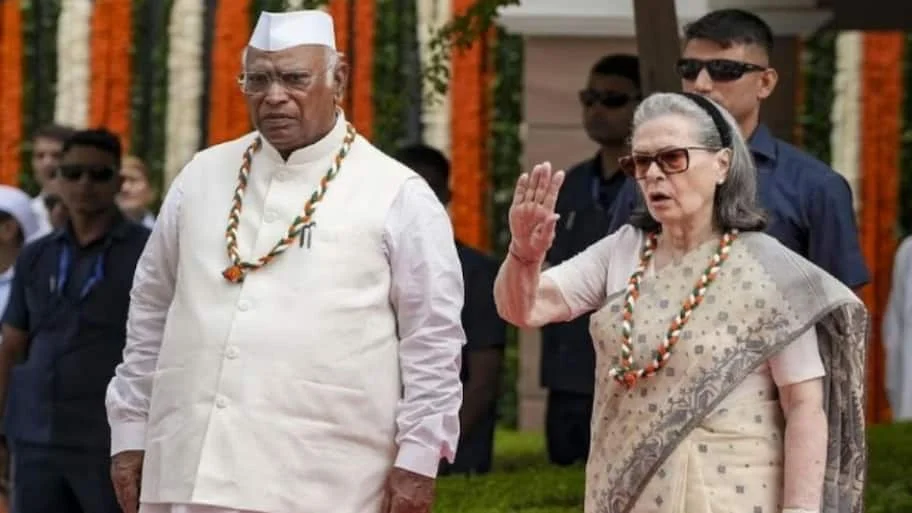
New Delhi: The Congress Working Committee has decided that party programmes will feature only the first two verses of ‘Vande Mataram’. The decision follows criticism from the Bharatiya Janata Party (BJP) over the singing of the national song at an Independence Day event and a later programme in Goa.
Rabindranath Tagore helped popularise the song during the Swadeshi and anti-Partition movements in Bengal and sang it at the 1896 Congress session. The first two verses have a different place in the history of the song.
How did ‘Vande Mataram’ become a national song?
Chattopadhyay wrote it in 1875, and Tagore sang it at the 1896 Congress session. The history of the song goes back well before Partition.
Both events took place before the partition of Bengal.
What did Congress decide in 1937?
The issue was formally debated at a Congress Working Committee meeting in Calcutta, now Kolkata, on October 30, 1937. Because congress leaders consulted him when they discussed objections to some of its verses in the 1930s, his views on the song are important to the debate. Because they had developed their own identity and inspirational value, he supported using the first two verses as the national song.
He wrote the complete poem could be interpreted in ways that might hurt Muslim sentiments. Nehru chaired the meeting, which was attended by several Congress leaders, including Vallabhbhai Patel, Rajendra Prasad, Maulana Abul Kalam Azad, Bhulabhai Desai, Jamnalal Bajaj, J B Kripalani, Pattabhi Sitaramayya, C Rajagopalachari, Acharya Narendra Dev, Jayaprakash Narayan and Subhas Chandra Bose. The CWC concluded that the first two verses, which had commonly been sung at the Congress and other public gatherings, should be adopted as the national song. It recommended that only those two verses be sung at national gatherings, with Tagore’s version and musical composition being followed.
