
By Dr. Abhay Pandey
Political Context
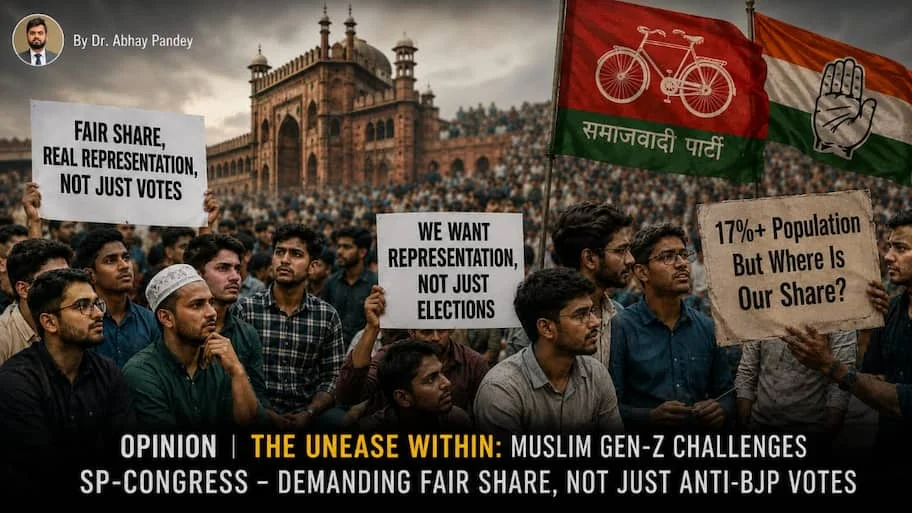
It is precisely this shift that could emerge as the biggest challenge for the SP and the Congress ahead of 2027. For long, the Muslim vote in Uttar Pradesh has been regarded as a rock-solid base for the Samajwadi Party. The Congress, too, has continued to treat the Muslim community as part of its traditional social support. Election after election, both parties have sought to keep Muslim voters on their side by presenting themselves as the strongest political alternative against the BJP. But the question is no longer the same. The question is no longer merely, “Which way will the Muslim vote go? The question now is, will Muslim Gen-Z accept the old political arithmetic in the same unquestioning manner as previous generations did? For the new generation is no longer asking only whom to defeat; it is also asking, “What have we received, and what is our share? Social media has transformed the very architecture of politics. That is why treating Muslim Gen-Z as the permanent vote bank of any single party could prove risky for both the SP and the Congress. Leaders such as Asaduddin Owaisi have repeatedly taken the SP and the Congress to task, asking why the Muslim community in Uttar Pradesh remains confined to the role of spreading carpets and mobilising crowds. These questions resonate with a section of Muslim Gen-Z. Consequently, this generation is now demanding representation proportionate to its population. It is asking: if its vote is so crucial, why is the community’s political voice not correspondingly strong? This is the reason that questions—and even resentment—towards the SP and the Congress are now emerging from within the Muslim community itself.
Earlier, a voter had limited sources of political information. Today a young person can listen to a leader’s speech, examine past statements, discuss a candidate’s politics, and compare the claims of different parties.
Votes alone are not enough: The question of political share
Muslims constitute nearly 20 per cent of Uttar Pradesh’s population. Put simply: we must defeat the BJP; therefore, we must vote for the SP or the Congress. Against this backdrop, it is only natural for Muslim Gen-Z to ask how much actual participation an community of this size enjoys in the Assembly, Parliament, party organizations and key decision-making processes. This is exactly where the gap between the old politics and the new becomes visible. On social media, a section of Muslim Gen-Z is steadily raising the question: the community has consistently stood with the SP and the Congress in the state’s politics, yet what justice have these parties rendered in return? Do they occupy high offices? Do these parties truly raise issues of their rights? Or are they merely used as a vote bank? In other words, the question is no longer confined to “whom to defeat? Muslim Gen-Z has moved beyond that old frame. Its straightforward logic is that their vote bank has always been mobilized around the single agenda of whom to stop. But Gen-Z is now persistently asking on social media— “What will we get? What will be our share? How many leaders from our community will rise to positions of leadership? It is this very shift that is causing discomfort within the SP and the Congress.
