
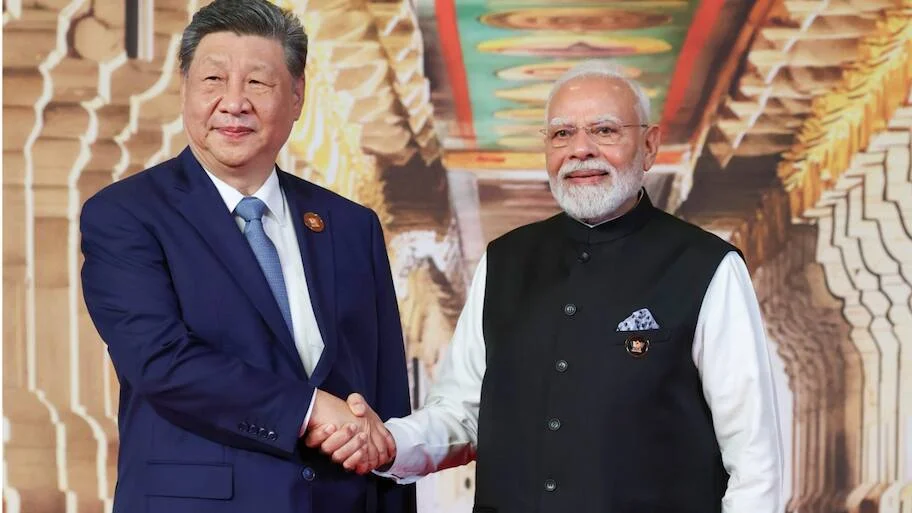
Prime Minister Narendra Modi and Chinese President Xi Jinping held bilateral talks on the sidelines of the 18th BRICS Summit at Bharat Mandapam in New Delhi on Saturday, with both leaders striking a notably warm tone as the two Asian giants continue working to stabilise ties strained since the deadly Galwan clashes of 2020.
“It gives me great pleasure to extend a warm welcome to you,” he said, adding that he was grateful for “the support and cooperation received from China during India’s BRICS chairmanship. Despite their differences, Xi said, the two nations “have been able to support and help each other to achieve common development. We encourage increasing efforts, through dialogue and diplomacy, towards a long-term understanding that will contribute to lasting peace, security and stability in the region,” the declaration said. Earlier reporting noted: Addressing the summit in New Delhi, Xi said China would work with other BRICS members towards that goal, arguing that the conflict in the Middle East “does not serve the common interests of the international community”, according to Reuters.
Opening the meeting, PM Modi thanked Xi for Beijing’s backing of India’s BRICS chairship this year. The Chinese leader also struck a reflective note about the frequency of his meetings with PM Modi, pointing out that this was his second visit to New Delhi in twelve years, during which the pair have met more than twenty times, producing what he termed “a series of important consensuses.
Earlier reporting noted: “We urge to ensure the protection of civilians and civilian infrastructure in accordance with the purposes and principles of the Charter of the United Nations in their entirety and interconnectedness, including respect for the sovereignty and territorial integrity of the States. Earlier reporting noted: PM Modi meets Xi Jinping at BRICS Summit as India-China ties show signs of thaw Prime Minister Narendra Modi held a bilateral meeting with Chinese President Xi Jinping on Saturday on the sidelines of the BRICS Summit in New Delhi, as the two countries seek to build on a recent improvement in relations following years of tensions.
Beyond the bilateral talks, BRICS members unanimously adopted the New Delhi Declaration 2026, voicing deep concern over rising tensions in West Asia and calling for restraint to prevent further escalation. Xi confirmed that China will assume the BRICS chairship next year and host the 19th summit, saying Beijing would use the role to build consensus among members.
Ahead of Xi’s arrival, China’s ambassador to India, Xu Feihong, said Beijing intended to “handle the bilateral relations from a strategic height and long-term perspective” and to work through outstanding differences as neighbours. Addressing the summit, Xi described the ongoing conflict as damaging to the entire region and said it ran counter to the wider interests of the international community. Xi called for a “permanent, comprehensive ceasefire” and pledged that China would work alongside fellow BRICS members to help restore peace in the Middle East, according to Chinese Foreign Ministry spokesperson Mao Ning. He argued that the Global South needed to move from being a “rule-taker” to a “rule-shaper,” noting that developing nations remain at the sharp end of global crises while still being left out of the rooms where decisions get made. “Together, we will usher in the third golden decade of BRICS cooperation,” he said. India is hosting the two-day 18th BRICS Summit on September 12-13 under the theme “Building for Resilience, Innovation, Cooperation and Sustainability,” bringing together leaders from member and partner nations alongside a number of outreach guests.
Xi, for his part, framed the relationship in sweeping terms, describing China and India as the world’s two most populous nations and key members of the Global South, bearing what he called shared responsibility for humanity’s future. He urged both countries to deepen cooperation within the wider BRICS framework and to champion “an equal and orderly multipolar world. External Affairs Minister S. PM Modi also gave Xi a brief explanation of the Ramanathaswamy Temple backdrop chosen for the summit’s welcome ceremony. The declaration pressed for the protection of civilians and civilian infrastructure, urged unhindered humanitarian access into Gaza, and called on all sides to observe existing ceasefire arrangements. The bloc also flagged serious concern over attacks on civilian infrastructure and safeguarded nuclear facilities, insisting that nuclear safety and security must hold even amid active conflict, and called for full implementation of relevant United Nations resolutions. Speaking at the summit session on global governance, PM Modi put forward ten proposed measures for reform, which he suggested BRICS members could shape into a formal Reform Roadmap ahead of next year’s gathering.
Jaishankar and National Security Advisor Ajit Doval were among the officials present for the talks, which followed a lighter moment earlier in the day when PM Modi, Xi and Russian President Vladimir Putin were photographed holding hands and smiling together at Bharat Mandapam. Saturday’s meeting was the third consecutive year the two leaders have met face to face, following earlier encounters in Kazan and Tianjin.
