
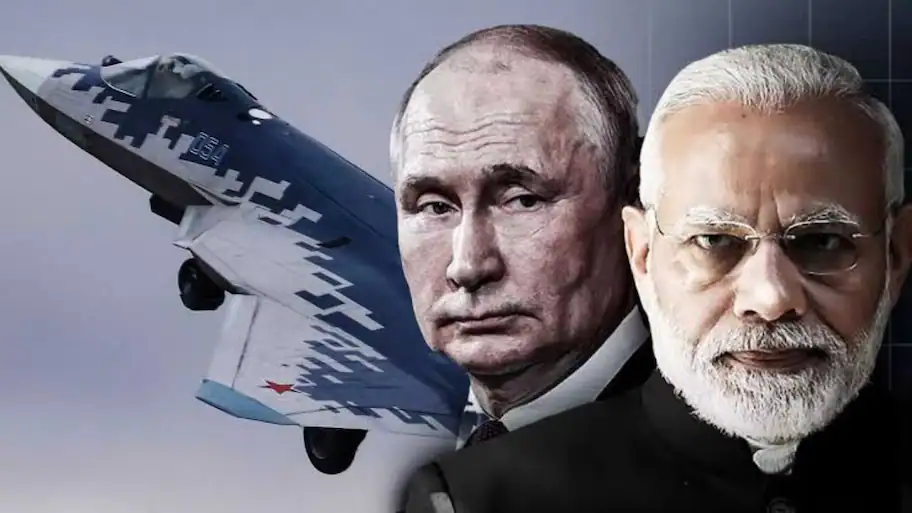
New Delhi: Russian President Vladimir Putin is set to land in New Delhi on Friday (September 11) for the BRICS Summit and talks with Prime Minister Narendra Modi. Crude oil, trade corridors and defence projects are expected to be on the agenda, including the possible addition of Su-57 (Russia’s fifth-generation fighter) to India’s fleet.
India is authorised to have 42 fighter squadrons, while the IAF presently has around 28. The country is also waiting for 114 Rafale fighter jets, while the indigenous Tejas programme depends on the supply of US-made engines.
Defence analysts said India has a strong reason to consider the Russian fighter as the Indian Air Force (IAF) is dealing with a shortage of combat squadrons and preparing for possible threats on two fronts. Against this backdrop, they said the country needs a stealth fighter in the near term. The Advanced Medium Combat Aircraft (AMCA) is expected to take at least another decade to enter service.
He said India could potentially sign a deal for one or two Su-57 squadrons. An agreement covering three more S-400 squadrons or the S-500 air defence system could also be discussed. If India and Russia can find a way to deal with the possible US sanctions, a Su-57 agreement could move ahead, according to Parihar.
Modi and Putin’s talks will therefore carry discussions on several defence projects, including the possible addition of Russia’s fifth-generation fighter to India’s fleet.
Russia is willing to offer technology transfer, he said. The main issue for India is the possibility of US sanctions under the Countering America’s Adversaries Through Sanctions Act (CAATSA).
Then why is India buying Rafale?
“The Su-57 is Russia’s fifth-generation stealth fighter and has been used in combat operations. The F-35 is another option for the country, and the United States has offered the fighter to New Delhi. He acknowledged that it is an advanced stealth aircraft, but listed several reasons why India may prefer the Su-57. The F-35 is more expensive than the Su-57. He said the F-35 also comes with high maintenance and flying costs. The United States is not ready to give India the F-35’s technology or source code, according to him. He also said the Rafale is less expensive than the F-35. Asked whether India could deal with threats from China and Pakistan if it gets some Su-57 squadrons along with the 114 Rafales, he said India would be in a stronger position. This means comparisons between China’s J-20 or J-35 and Russia’s Su-57 cannot be based only on which aircraft would perform better in a close-range fight, Paarihar explained. China’s J-35 is described as a fully stealth aircraft, but Beijing has not sold it to another country and it has not been used in an actual military operation, according to him. He also said questions have been raised over the J-20. Parihar said there is a strong possibility of an agreement on the Su-57, though he did not predict whether an official announcement would be made during the visit.
Because russia has used it in operations, the Su-57 has an advantage in his assessment. India therefore has a better idea of the aircraft’s strengths and weaknesses.
When asked whether India has any real choice when it comes to adding a stealth fighter, former Air Force Wing Commander KS Parihar said the country needs a platform that can meet its immediate requirements as it prepares for a possible two-front or two-and-a-half-front situation. Only five stealth fighter aircraft are presently available in the world, according to him. The Air Force has some information about its capabilities and limitations,” he said. He also referred to India’s experience with the US-made engine for the Tejas programme and said it haas led to a lack of trust. Parihar said the relationship between India and France has a different level of trust. Talks over access to the source code are still underway, according to him.
The United States has two, China has two and Russia has one. The first is cost. Another issue is India’s dependence on the United States for the aircraft’s operational support. Parihar’s biggest objection is about technology transfer. The same issue was raised with him in relation to the French Rafale. France is also not offering India the complete technology or source code for the fighter. He mentioned France’s record of delivering aircraft promised to India on schedule. Paris has agreed to work with Delhi on manufacturing the aircraft under the ‘Make in India’ programme and is also helping India with engine-related work. He also argued that modern air warfare has moved away from the traditional idea of close-range dogfights. He cited the Russia-Ukraine war, the US-Iran conflict and Operation Sindoor as examples of aircraft carrying out attacks from their own territory or surrounding waters.
