
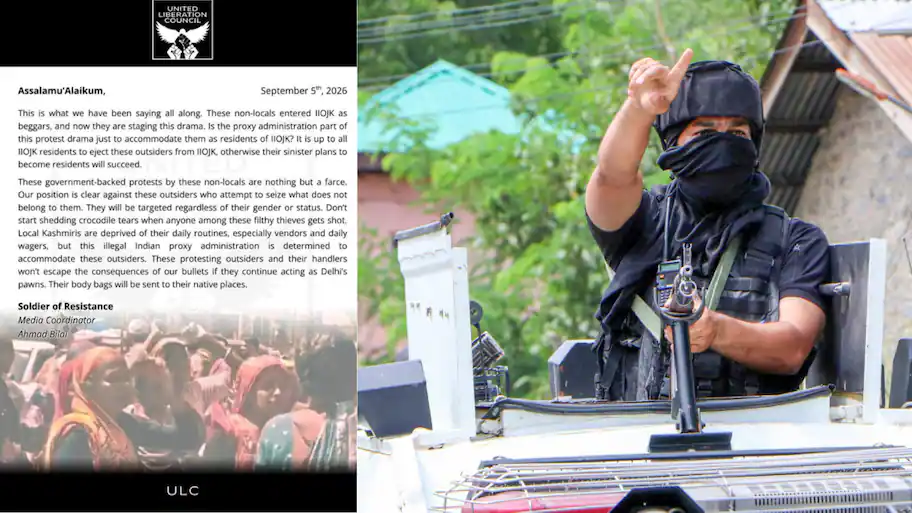
A fresh threat communication purportedly issued by the United Liberation Council (ULC), described by Indian security agencies as an online proxy front of the banned Lashkar-e-Taiba (LeT), has surfaced on social media, this time specifically targeting non-local migrant workers in Jammu and Kashmir.
The latest ULC communication also follows a series of threats issued by the group in July and August 2026, which primarily targeted Kashmiri Pandit employees working under the Prime Minister’s rehabilitation package.
The threat, according to the communication, applies irrespective of their gender or status. The message alleges that these “outsiders” entered Jammu and Kashmir as beggars but are now staging protests, allegedly with the backing of the “proxy administration”, to gain residency in the region. It calls on local residents to eject them and describes the protests as a “farce”. The communication further warns that those who continue to act as “Delhi’s pawns” will not escape “the consequences of our bullets”, adding that their bodies would be sent back to their native places. This is a conspiracy…” Abdullah said.
The letter accuses migrant labourers of attempting to settle permanently in the region and warns them of violent consequences if they do not leave. The latest threat comes at a time when migrant workers in the Valley are already apprehensive following the recent targeted killings of two brick-kiln workers in Kulgam district in July. Such attacks have repeatedly triggered fear and panic among seasonal migrant workers in Jammu and Kashmir. A large number of seasonal workers from different parts of India travel to the Valley for employment each year. Many are engaged by local residents and businesses in construction work, brick kilns, orchards and other seasonal activities. Those communications reportedly named individuals and disclosed personal information, including addresses and vehicle registration numbers, while warning of surveillance and possible targeting. Security agencies have viewed such communications as a form of psychological warfare intended to create fear and discourage the return and rehabilitation of Kashmiri Pandits. Kashmiri Pandit employees have also been protesting and seeking enhanced security in the wake of the threats. Speaking recently in Anantnag, Farooq Abdullah alleged that the threats could be part of a conspiracy by the Lieutenant Governor-led administration to create fear and delay the restoration of statehood in Jammu and Kashmir. He questioned why Kashmiri Pandit employees were receiving threats allegedly from a little-known group called the United Liberation Council (ULC), with their personal details being leaked, while senior Hindu officers posted in Jammu and Kashmir from outside the region—including the DGP, DIGs, SSPs, district SPs and Deputy Commissioners—were not facing similar threats. “Who is giving this threat? … Why are they not getting this threat? He directly blamed the administration led by Lieutenant Governor Manoj Sinha, who controls police and public order, alleging that an atmosphere of fear was being created despite official claims that peace had returned to the region and militancy had been wiped out. Farooq Abdullah’s remarks differed from those of his son, Chief Minister Omar Abdullah. Omar had raised concerns over the threats to Kashmiri Pandit employees and called for a probe by the Ministry of Home Affairs, questioning why the community was being singled out. Meanwhile, agencies continue to verify the authenticity of individual threat communications while monitoring them as potential indicators of an intent to intimidate civilians or escalate violence against soft civilian targets. The latest message adds to a broader pattern of alleged intimidation by LeT-linked shadow outfits, with threats increasingly seeking to exploit communal and demographic fault lines in Jammu and Kashmir.
Authorities in Jammu and Kashmir, including Chief Minister Omar Abdullah, have previously described ULC-style posters and threats as a serious concern and directed police and security agencies to treat them with due seriousness. Former Jammu and Kashmir Chief Minister and National Conference chief Farooq Abdullah has questioned the authenticity and motive behind the earlier threat letters and called for a deeper probe.
