
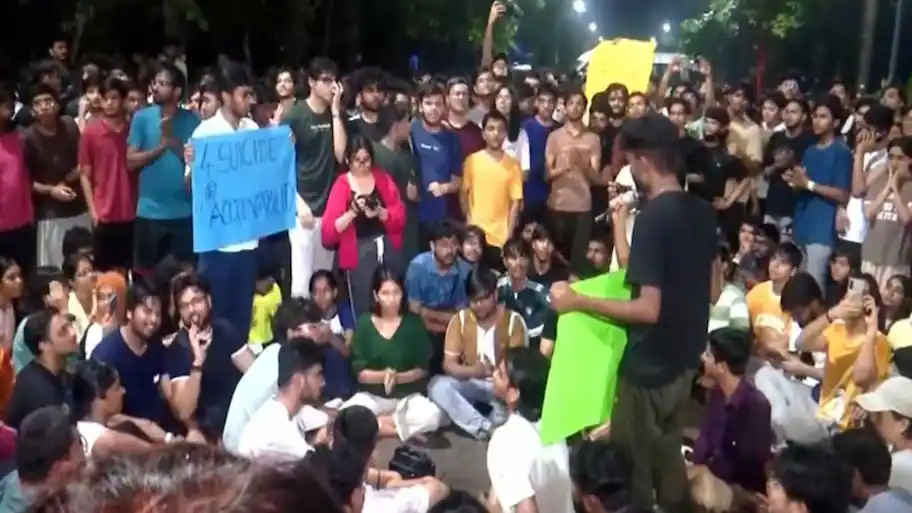
The confrontation at IIT Bombay moved into a new stage late on Sunday when the administration agreed to advance an 18-point charter submitted by the protesting students. Shireesh Kedare signed the document after an extended discussion with the students, who had been on a sit-in near the main campus gate for three days. Director Prof.
One of the central demands put forward by the protesting students is a call for action against Professor Suryanarayana Doolla, who was invigilating the examination in which Wakode appeared shortly before his death.
This development occurred against the backdrop of mounting calls for accountability after the death by suicide of 22-year-old student Sahil Wakode on the evening of 18 September.
IIT-Bombay said Wakode had uploaded the examination question paper to an AI platform to seek answers, but maintained that no disciplinary proceedings had been started against him. The student was counselled and assurance was given to him that the incident would not have any adverse impact on his academic career, according to the institute. Professor Doolla has been named in the First Information Report filed by the Mumbai Police following a complaint filed by Wakode’s parents. Authorities have booked a case of abetment to suicide and applied sections of the SC/ST (Prevention of Atrocities) Act after the family alleged caste-based harassment. The probe has now been handed over to the Mumbai Crime Branch. The students’ call for action against Doolla stems from the examination episode involving Sahil Wakode. Wakode was later found dead in his hostel room. IIT-Bombay has denied allegations of caste discrimination, stating that he had not filed any such complaint with either the institute’s SC/ST cell or its administration.
The second-year Energy Science and Engineering student was reportedly found with a mobile phone during a mid-semester test on Friday.
What does the 18-point charter demand The 18-point charter extends well past the issue of Doolla’s suspension. The students have called for an independent probe into the events leading to Wakode’s death, requiring an interim report by 30 September and a final report by 15 October.
When the issue was raised during the meeting with protestors, Kedare said that the institute would “follow the process”, reported India Today. They have further insisted on an open-house meeting with the director, the Dean of Student Affairs and other senior administrators, along with an apology for what they termed the public “defamation” of Wakode, according to reports. A subsequent comment from an institute official reinforced that the issue would be handled through due procedure, indicating that endorsement of the charter did not constitute an instant resolution of every specific request. This late-night progress came after almost three hours of talks involving the student protesters and senior representatives of the IIT Bombay administration. The charter itself covers calls related to the inquiry into Wakode’s death, together with broader reforms to the institute’s academic, disciplinary, and student-welfare frameworks. What is the case and the development so far
