
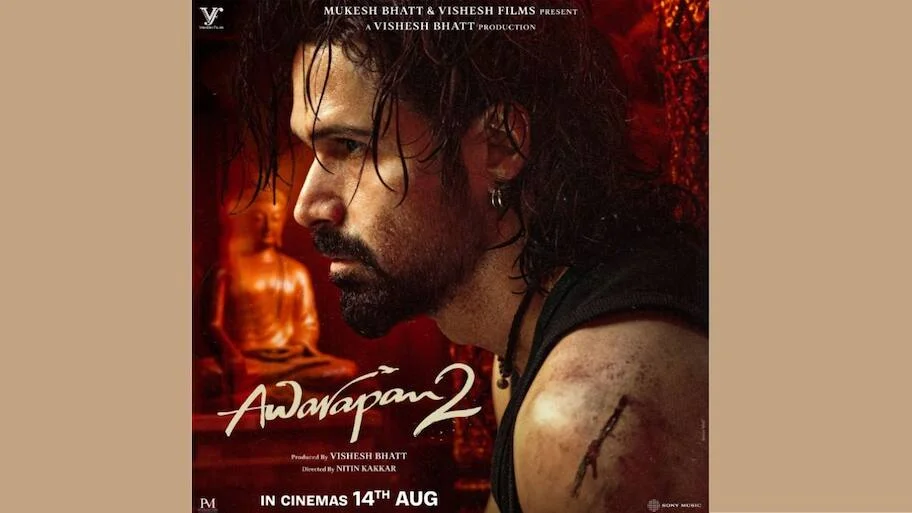
He played the role of hitman named Shivam in ‘Awarapan’, in 2007, and the movie became a rage and his brooding masculinity turned into a trend, which many tried to copy but no one could actually ace it. Now, after almost two decades later, when the market is jammed packed with mega-budget action escapades, ‘Awarapan 2’ brings the old-school charm, with a perfect blend of story, emotions, music and scale. There is something intoxicating about watching Emraan Hashmi, playing the role of a bad-boy with a soul on-screen.
The first thing ‘Awarapan 2’ gets right is understanding that Shivam Pandit cannot simply return as a gangster. His story ended in 2007 with a sense of emotional closure, so bringing him back required a new reason for him to pick up that life again. The original was much more personal and intimate, while Awarapan 2 operates as a larger crime thriller. It is recognisably part of the same franchise, but it isn’t trapped inside the filmmaking language of 2007. Emraan and the Vishesh Films/Bhatt combination have a history with this kind of emotional, music-driven crime drama, and Awarapan 2 feels like a continuation of that creative partnership. There is no point pretending that ‘Awarapan 2’ is identical to the original. The story has progressed from 2007 to 2026, and Shivam is no longer the same man we left behind. With Emraan Hashmi at the centre, strong support from Disha Patani and Shabana Azmi, a striking performance from Puran Gabbi, a soundtrack that remains central to the storytelling and Vishesh Bhatt’s clear franchise vision, Awarapan 2 earns its place as a worthy continuation.
Because shivam has moved on, the film has moved on. Because she chose a life of crime, she is not there. Because awarapan 2 exists as a franchise largely because of his vision, vishesh Bhatt’s role in the sequel deserves to be underlined. Because some of its surprises are best left for the theatre, even the marketing begins to make more sense after watching the film.
A look or a pause often says more than a long piece of dialogue. “Tera Mera Rishta” and “Toh Phir Aao” return in reimagined forms, again through Mithoon, and Arijit Singh’s “Yeh Awarapan” gives the sequel a new song that belongs to the same emotional universe. The film finds that reason in a child. Shivam, played once again by Emraan Hashmi, is visiting Aaliyah’s grave when he discovers an abandoned infant. He leaves the graveyard with the baby, takes her to an orphanage and begins quietly funding her upbringing. He calls her Aaliyah. It is almost as if he is trying to give someone else the life that the original Aaliyah never got. Director Nitin Kakkar and writer Bilal Siddiqui build the sequel around that emotional contradiction. Shivam is both trying to escape his old identity and being forced to use it again. The difference this time is the scale. The story moves through organised crime, trafficking, drugs, revenge and sacrifice, with bigger action set pieces and a more commercial structure. Emraan Hashmi is completely comfortable in this world. He doesn’t play Shivam like a man who has suddenly become heroic. There is still anger in him, but there is also weariness. He knows what violence costs, and that makes the character more interesting when he is forced to use it again. Hashmi’s screen presence does much of the work. It is also impossible to separate his performance from his association with Vishesh Films. Disha Patani’s Zara brings another side of that criminal world into the story. She is the sister of Zorawar, played by Puran Gabbi, and becomes an unintended victim of the circumstances created by her family. Patani gives Zara a grounded vulnerability, while Gabbi brings an edge to Zorawar that makes him stand out. He is one of the film’s pleasant discoveries and brings an energy that the role needs. Shabana Azmi’s Nafisa sits at the centre of the trafficking operation and gives the film a formidable presence on the other side of Shivam. Suvinder Vicky as Jaideep, Vijayant Kohli as Mehmood, Atul Kumar as Samarth and Aniruddh Rawal as Sikandar complete a supporting cast that helps make the world feel populated and lived-in. If the film has one element that understands the franchise almost instinctively, it is the music. Mithoon, Amaal Mallik and Jeet Gannguli continue the musical tradition, while Sayeed Quadri and Rashmi Virag provide the lyrics. More importantly, the music isn’t treated as an interruption between scenes. It is woven into the narrative. The songs carry memory, longing and atmosphere. The difference becomes particularly noticeable in a theatre. The sound design and scale of the music make the film a much more complete audio-visual experience on a large screen, which is where these songs really need to be heard. He was the co-producer of the original and returns as the writer and producer of the sequel, with the idea of taking Awarapan forward rather than treating it as a one-film memory. That larger creative direction is visible in the way the team has approached the sequel. Kakkar directs it, Siddiqui writes it, the actors bring the characters to life, and the entire team follows the larger vision of building the next chapter. The campaign creates the curiosity; the film supplies the answers. It isn’t. It is larger, more action-heavy and more firmly structured as a commercial thriller. But that difference is also what allows the franchise to move forward. He is still carrying the same pain, but now he has another reason to fight. It may be a different film from the original, but it feels like the story has actually continued.
