
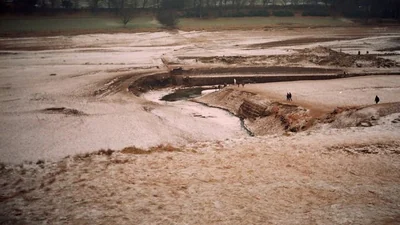
A village submerged more than 80 years ago is beginning to re-emerge as a prolonged dry spell sends water levels plunging. The remains of Derwent, once home to a close-knit community in the Upper Derwent Valley, are becoming visible beneath the retreating waters of Ladybower Reservoir.
The reservoir was less than 32% full this week after months of below-average rainfall and above-average temperatures, according to FloodRadar data. The Environment Agency states that all 10 reservoirs monitored across the Midlands remained below their average storage levels for this time of year at the end of September. Storage levels ranged from 24% to 72% full, while the East Midlands remained under drought incident status.
The East Midlands was officially placed into drought status in August, and the continuing shortage has left reservoirs across the region well below their usual levels for the time of year. But while the exposed ruins have attracted attention, water managers see the low levels as a warning about the pressures facing supplies. What is happening now is more than a curious archaeological spectacle. Ladybower’s falling water level reflects a wider deterioration in England’s water resources.
It was officially opened by King George VI in September 1945. Derwent’s final church service took place in March 1943. Because of safety concerns, it briefly became visible above the water when levels fell in 1947, but was dynamited later that year. Because the exposed reservoir bed is muddy and dangerous, however, this time, the authorities have advised tourists to stay on the marked routes.
For residents, the project meant the loss of homes, farms, roads, churches and an established way of life. The village church spire was deliberately left standing as a memorial. Ladybower was constructed to increase the region’s capacity to cope with water shortages. It is a stark reminder of how quickly a landscape can change, especially one built on the assumption of a steady water supply.
Graves from the churchyard were exhumed and moved to Bamford, while buildings were demolished before the rising reservoir waters covered the valley. Today, the re-emergence of Derwent gives historians a rare chance to see the remains of the settlement.
