
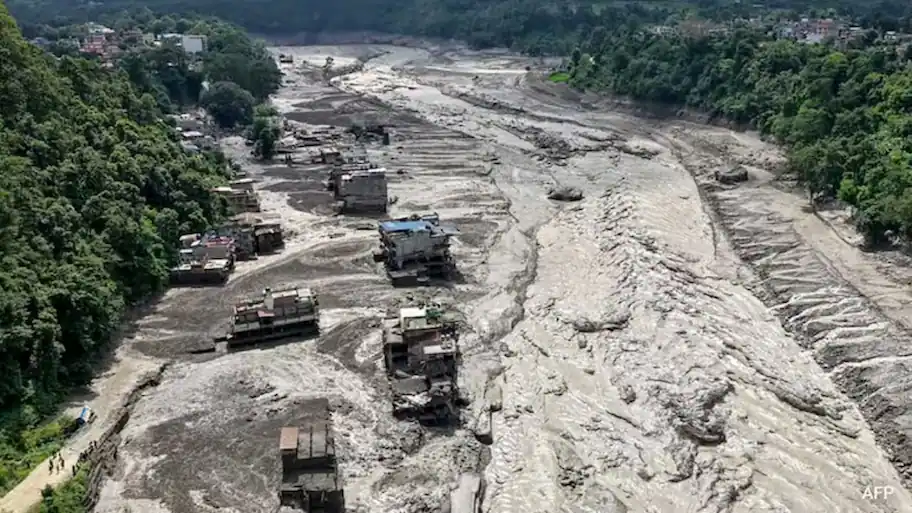
New Delhi: The floods and landslides in Nepal have severely damaged the Rasuwa route used by pilgrims travelling to Kailash Mansarovar through Tibet. The route runs from Kathmandu to the Rasuwagadhi border point before entering Tibet, and the flash flood has damaged roads and bridges along the way.
The Mount Kailash, which rises to 6,638 metres above sea level, and the Lake Mansarovar hold great religious importance for Hindus, Buddhists and Jains. Nepal’s Bhotekoshi and Trishuli rivers were hit by sudden flooding, affecting Rasuwa, Nuwakot, Dhading, Gorkha and Chitwan districts. Roads, bridges and communication links in Rasuwa were badly damaged, creating problems for people travelling towards the Nepal-China border. The route is used by pilgrims travelling from Kathmandu towards Tibet and then onward to Kailash Mansarovar. The journey involves long road travel, high-altitude conditions, border formalities and a trek around one of the world’s most important pilgrimage sites. Hundreds of pilgrims travel to the region every year.
Who can apply for Indian government route?
The Lipulekh route involves around 200 kilometres of trekking. The Nathu La route involves about 36 kilometres of trekking. The road journey through Gyirong in Tibet and Rasuwa in Nepal takes around 10 to 14 days, according to The Indian Express. The helicopter option generally takes around five to 11 days. 13,523 travellers passed through the Rasuwagadhi border point during the 2025-26 financial year, according to Nepal’s Tourism Department. Applicants must be Indian citizens and must hold an Indian passport with at least six months of validity as of September 1. They must be at least 18 years old and no more than 70 years old as of January 1 of the year of the pilgrimage. Applicants must also have a Body Mass Index (BMI) of 25 or below. Before departure, pilgrims have to submit a valid passport, six passport-size colour photographs and a notarised indemnity bond worth Rs 100 to the designated officials. The estimated cost of the Lipulekh Pass route in 2025 was Rs 1.74 lakh, according to the MEA website. The estimated cost of the Nathu La route was Rs 2.83 lakh.
Because the permits are secured in advance, travellers generally do not have to wait at Rasuwagadhi for these documents. Because the two routes operated by the Indian government are available only to Indian citizens, the route is popular among foreign travellers. Physical fitness is therefore an important part of the journey.
Private organisations do not operate the Kailash Mansarovar Yatra through the Lipulekh and Nathu La routes, according to the Ministry of External Affairs (MEA). The Indian government organises the Kailash Mansarovar Yatra between June and September through two routes – one is through Lipulekh Pass in Uttarakhand, via Dharchula or Delhi, while the other goes through Nathu La Pass in Sikkim, via Gangtok or Delhi. A third option starts from Kathmandu and is operated by private tour operators. Pilgrims travel from Kathmandu towards the Nepal-Tibet border and then enter Tibet before continuing towards Kailash Mansarovar. The Nepal route has two main options. One is a road route through Rasuwa and the Gyirong border point, while the other uses flights and helicopters through Nepalgunj and Simikot/Hilsa. The trip begins in Kathmandu, continues by road to the border and then proceeds in Tibet towards Darchen. The trek starts from Darchen. Pilgrims travel from Kathmandu to Nepalgunj, take a small aircraft to Simikot and then travel by helicopter to Hilsa near the border. From there, the journey towards Purang and Mount Kailash includes road travel over shorter distances. Altitude is one of the main physical challenges on these routes. The journey involves travelling through high-altitude areas before pilgrims reach the Kailash region, making physical fitness an important part of the preparation. Pilgrims travelling through Nepal also need a valid passport and special Chinese permissions. These include a Chinese group visa and a Tibet Travel Permit. Rasuwa and the Rasuwagadhi border point form a major gateway for people travelling from Nepal to Tibet for the Kailash Mansarovar pilgrimage. The journey usually begins in Kathmandu, passes through Rasuwa district and reaches Rasuwagadhi on the Nepal-China border. After crossing the border, travellers enter Tibet through the Gyirong port and continue towards Kailash Mansarovar. The journey from Kathmandu to Rasuwagadhi normally takes around six to eight hours. The journey from Kathmandu starts after the paperwork has been completed. The Kailash Mansarovar journey involves long road journeys, trekking and travel through high-altitude terrain. Conditions can change fast in mountain areas, while roads, bridges and communications can be affected by floods, landslides and other natural events. The Nepal route also depends on road and air links across several locations. Travellers using the helicopter option have to move through Kathmandu, Nepalgunj, Simikot and Hilsa before entering the Tibet region. The final stages of the pilgrimage involve reaching the Kailash area and undertaking the required walking routes at high altitude. The MEA has set eligibility rules for the Kailash Mansarovar Yatra organised by the Indian government. They must be medically and physically fit for the journey. Foreign nationals cannot apply for the government-organised pilgrimage. Overseas Citizen of India (OCI) cardholders are also not eligible. After an online application, pilgrims are selected through a draw conducted by the MEA. The route and batch are allotted along with the selection. The ministry requires pilgrims to travel and return as a group, with New Delhi serving as the starting point for all participants. They must also provide an affidavit covering emergency helicopter evacuation and a consent document allowing cremation of their remains in Chinese territory in the event of death during the journey. Any missing or incomplete document can lead to the pilgrimage being denied.
The required Chinese group visa and the Tibet Travel Permit have to be arranged and approved before the journey begins. Medical checks are carried out before the journey begins.
