
ALEKSANDAR VUCIC has ruled Serbia for 14 years, controlling its media, economy and police so completely that the country was not considered a true democracy. But it turned out to be democratic enough. Polls had suggested his Serbian Progressive Party (SNS) might lose, but none had predicted the apparent scale of the rout.
Less than two hours after the polls closed in the legislative election on October 25th, Mr Vucic, who was previously president but was in the running to be prime minister, conceded defeat to a grassroots student movement with no clear public policies or leadership.
The opposition Student List won 53% of the vote, compared with 39% for the SNS. That would give the students about 140 seats in the 250-seat legislature, while the SNS gets about 103. At the Student List’s headquarters on the evening of the vote, Dejan Soskic, a former governor of Serbia’s national bank and a candidate to be an MP, said the group expected to win if turnout exceeded 63%. In the end it was 69%. In 2021 tens of thousands of Serbs demonstrated against a planned lithium mine. The government revoked the mine’s permit, but reinstated it in 2024 just before signing a strategic partnership with the European Union aimed at reducing dependence on Chinese batteries for electric vehicles. Then in November 2024 a railway-station canopy collapsed, killing 16. Over the past 14 years most of the country’s media has been brought under the control of Mr Vucic and his supporters.
He blamed his loss on a conspiracy organised by “various European countries and the US’s deep state, the one that is against President Trump”. It makes its decisions in university “plenums”, which selected 250 candidates for parliament. Students led mass demonstrations, ultimately demanding that Serbia’s government, administrative and judicial system, which they said had been captured by Mr Vucic and his party, be purged and rejuvenated. In the election, the Student List campaigned under the slogan “Serbia or the Mafia”. One involved a whistleblower who said he was paid for “phantom jobs” by public companies; his real task was to provide hired muscle to the SNS to provoke violent incidents with students, which could then be blamed on them.
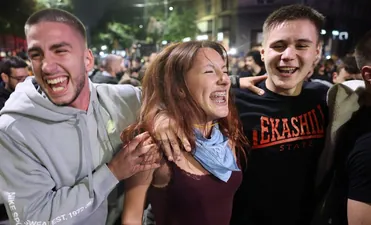
The crucial factor was turnout. During the day the mood in Belgrade, the capital, had been tense, with riot police deployed in the city centre and groups of hooded young men—presumably hired toughs—at a pro-government encampment next to the presidential building. Once Mr Vucic conceded, the pro-regime forces vanished, the police departed and a jubilant crowd destroyed the camp. Tens of thousands of citizens poured onto the streets to dance and celebrate. After two terms as president, Mr Vucic was ineligible to run again and had stepped down early to run for prime minister. In fact the group that beat him is a leaderless movement that grew out of years of student-led protests against mining projects and corruption. None of the candidates are students; they include academics, doctors, actors and other prominent figures from civil society. The source of Mr Vucic’s defeat lies in Serbia’s growing corruption and authoritarianism , which led to successive waves of protests. This provoked another upsurge in protests. China has become a big investor in Serbia under Mr Vucic, and the canopy construction had been contracted through a Chinese consortium, though sub-contracted to Serbian companies; there were widespread allegations of corruption. It emphasised fighting corruption, restoring judicial and media freedom, modernising education and lowering the price of medicines. The students struggled at times to communicate. But some independent outlets still exist. Over the past two weeks they broke several stories that highlighted government corruption.
A Serbian political scientist at the Austrian Institute for International Affairs, it is a political earthquake comparable to the fall of Slobodan Milosevic, Serbia’s wartime leader, 26 years ago, according to Ivan Vejvoda. Mr Vucic’s fall will be compared to that of Viktor Orban, Hungary’s former populist strongman, who was defeated in April. As in Hungary, the opposition’s victory means not just a change of government; it could herald the dismantling of the country’s semi-autocratic system of rule.
