
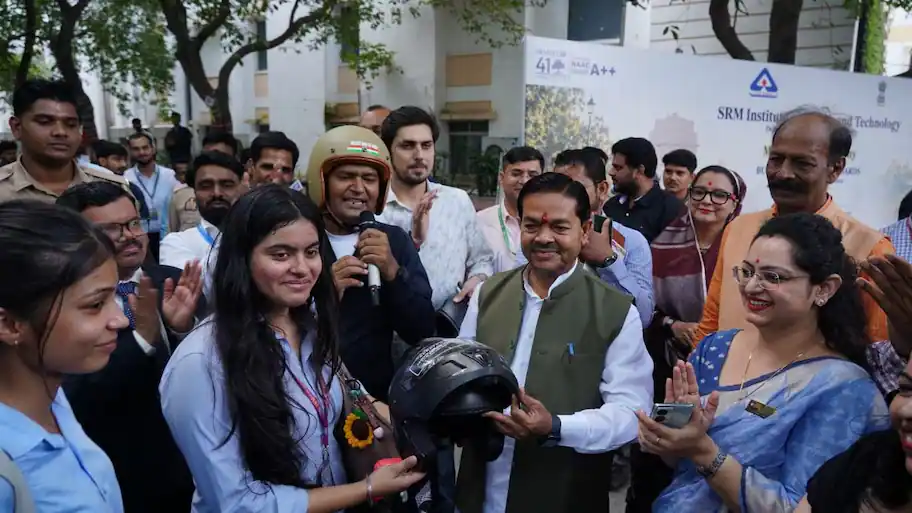
GHAZIABAD: More than 350 motorcyclists joined a road safety rally organised by the Bureau of Indian Standards (BIS) at SRM Institute of Science and Technology’s Delhi-NCR campus in Modinagar on Saturday. The event also saw the launch of a student Helmet Bank, over 40 quality awareness stalls and a formal agreement between BIS and the university to promote standardisation.
Organised by the BIS Ghaziabad Branch Office to mark World Standards Day 2026, the Manak Carnival focused on two-wheeler rider safety, quality products and consumer awareness. More than 350 riders travelled from the SRM University campus to Duhai RRTS Station before returning to the campus along the designated route. More than 40 stalls were set up by industries, testing laboratories and educational institutions as part of BIS Manak Carnival 2026. BIS also conducts awareness activities relating to Indian Standard IS 4151, which covers protective helmets for two-wheeler riders.
Because they do not have one available, the initiative is intended to discourage students from travelling without helmets simply. The BIS Ghaziabad Branch Office and SRM Institute of Science and Technology signed a Memorandum of Understanding during the event.
The programme concluded with the message: “Standards, when they are right, make everything right!” The programme was held under the Ministry of Consumer Affairs, Food and Public Distribution and brought together students, industry representatives, officials and members of the public. Union Minister of State BL Verma, who holds portfolios in Consumer Affairs, Food and Public Distribution and Social Justice and Empowerment, attended as the chief guest. BIS Chief Vigilance Officer Shweta Mishra, IRS, the Deputy Director General (Central Region) and other senior officials were also present. The Rider Safety Bike Rally was one of the main events at the carnival. The rally encouraged motorcyclists to wear protective helmets, observe traffic rules and check whether their helmets conform to Indian Standards. Raghvendra Kumar, known as the Helmet Man of India, supported the campaign, which also saw participation from personnel and representatives of the Central Reserve Police Force, Uttar Pradesh Police and the Indian Army. The campaign carried the message, “Look for the ISI Mark on your helmet, and make every ride safe and fantastic! A Helmet Bank was inaugurated on the SRM University campus to help students access helmets when needed, including during emergencies. Organisers emphasised that wearing a helmet should be treated as a basic safety precaution rather than merely a requirement under traffic rules. The initiative formed part of the wider campaign to encourage responsible riding practices among young people. They provided information on Indian Standards, product certification, testing procedures, hallmarking and consumer interests. The exhibition allowed visitors to learn how standardisation and quality assurance relate to products used in everyday life. Students and industry representatives could also interact with participating institutions and learn about testing and certification practices. The agreement aims to promote cooperation on standardisation, quality awareness and joint activities involving the university and BIS. The collaboration is intended to give students greater exposure to Indian Standards, quality assurance practices and consumer awareness programmes. The Ghaziabad event formed part of BIS’s continuing efforts to raise awareness about helmet quality and non-standard products. These activities include programmes involving helmet sellers, coordination with enforcement agencies and road safety sessions in schools. The standard formed part of the safety message promoted during the rally, with participants encouraged to look for the ISI mark when selecting helmets. Beyond helmet safety, BIS works with Standard Clubs, schools, colleges, industries, Resident Welfare Associations and community organisations to spread awareness about Indian Standards and consumer protection. Speakers at the carnival emphasised the responsibility of citizens to follow safe practices and choose quality-assured products.
