
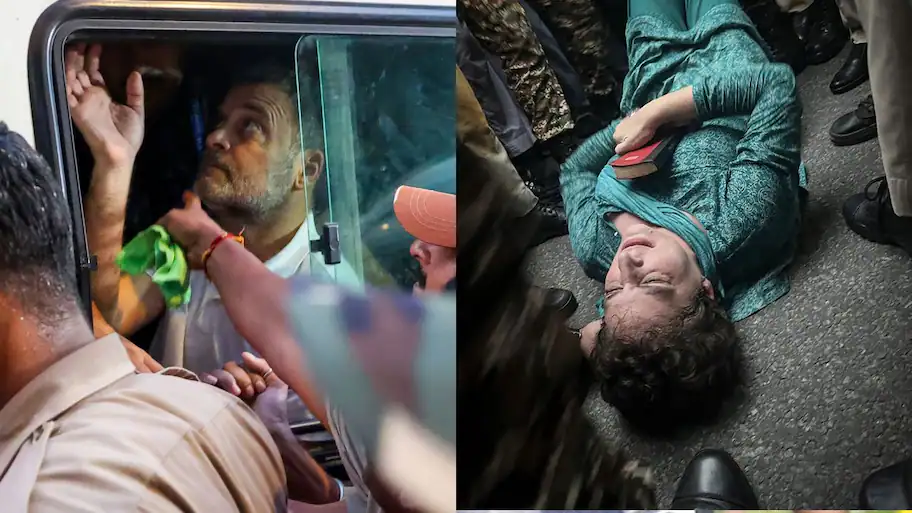
They were released shortly after 8 pm, according to an official quoted by IANS. Meanwhile, Congress MP Priyanka Gandhi Vadra and several other Opposition leaders were detained and taken to Chhatrasal Stadium after being removed from the protest site. Delhi Police released Congress leader Rahul Gandhi on Wednesday after detaining him for nearly two hours following a fresh round of INDIA bloc protests in the national capital.
Police said a further investigation was underway. The detentions took place on Ashoka Road when police intercepted three buses carrying Opposition leaders toward Jantar Mantar, where they planned to demand the resignation of Chief Election Commissioner Gyanesh Kumar. After being halted, Rahul Gandhi, Priyanka Gandhi Vadra, and other MPs stepped off the buses to proceed on foot. Police then took Rahul Gandhi into custody and placed him inside a police van as supporters climbed atop the vehicle in protest. Nearby, Priyanka Gandhi Vadra and several women leaders lay on the road holding copies of the Constitution before women police personnel forcibly removed them. The march followed a strategy lunch hosted by Congress President Mallikarjun Kharge at a restaurant in Janpath, where leaders resolved to escalate their campaign against the poll chief. Delhi Police registered an FIR against Rahul Gandhi, Priyanka Gandhi Vadra and others after a complaint alleging that they entered the Akashvani Bhavan premises without permission during Tuesday’s protest. He repeated his demand for CEC Gyanesh Kumar’s resignation and accused Prime Minister Narendra Modi, Home Minister Amit Shah, RSS chief Mohan Bhagwat and the CEC of damaging the electoral system. Those allegations have been rejected by the Election Commission and the BJP.
Delhi Police said no prior permission had been sought for that march, and Section 163 of the Bharatiya Nagarik Suraksha Sanhita was in force in New Delhi. Police detained around 260 protesters during the day, according to police accounts. The protests follow an Indian Express investigation that reported Election Commissioners Sukhbir Singh Sandhu and Vivek Joshi recorded objections on at least 14 occasions over 10 months to steps involving electoral rolls and related procedures.
It said the Commission’s final decisions had been unanimous. The Election Commission acknowledged the notes and described differing views as part of its internal decision-making process. On Tuesday, protests began with Opposition MPs trying to march from Parliament towards the Election Commission headquarters.
