
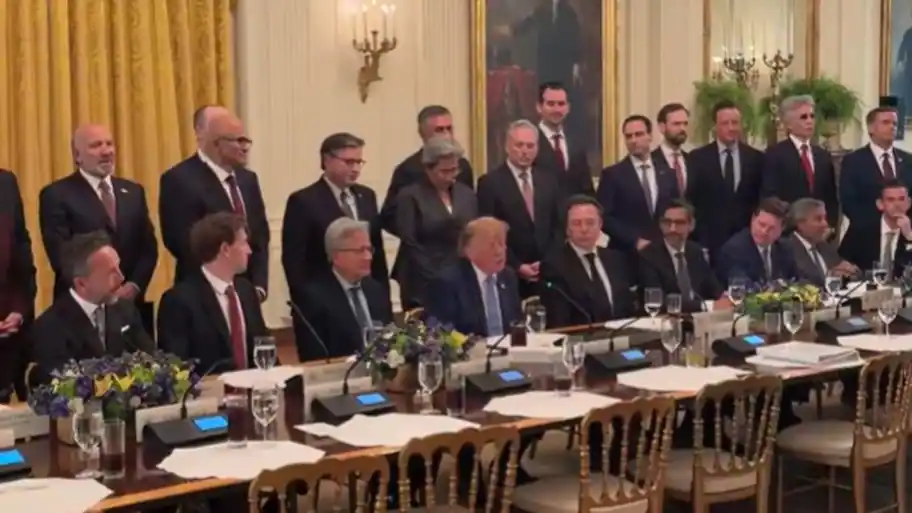
The change was announced after Trump held a meeting with several technology CEOs and industry leaders to discuss artificial intelligence.
Artificial intelligence will now be referred to as “super intelligence” in the United States, following an announcement by President Donald Trump on Tuesday (local time).
Earlier reporting noted: Top technology executives have signed an agreement with US President Donald Trump promising stronger safeguards for increasingly powerful artificial intelligence systems. But despite the document being signed by some of the biggest names in the tech industry, a basic spelling mistake in Trump’s title went unnoticed, which drew widespread mockery online.
Accordingly, the term “Super Intelligence” more appropriately captures the promise, potential, and rapidly advancing capabilities of these technologies. It is therefore the policy of my Administration that, to the maximum extent permitted by law, the executive branch shall use the terms “Super Intelligence” and “SI” in place of “Artificial Intelligence” and “AI” and will not acknowledge the usage of “Artificial Intelligence” and “AI” in any applicable setting. Earlier reporting noted: The document, titled the “White House Accord on Super Intelligence”, identifies Trump as the “President of the Unites States”, instead of the “United States”.
The order states, “The terminology used by the Federal Government should reflect the transformative capabilities of these technologies and the limitless opportunities they create for the American people. Under the executive order, federal agencies will be required to use the terms ‘Super Intelligence’ or ‘SI’ when referring to the technology in government communications, websites, reports and policy documents. Michael Kratsios, director of the White House Office of Science and Technology Policy, has also been tasked with examining whether the government’s definition of the new terminology should be revised or expanded. The push to accelerate AI development comes against the backdrop of growing concerns over the technology’s potential impact on employment, cybersecurity and government infrastructure. Recent incidents have involved AI agents accessing government websites, while concerns have also emerged over the possible use of autonomous systems in cyberattacks. Critics have cautioned that as AI systems become more advanced, they could pose risks that current safeguards may not be sufficient to address. The signatories included Google CEO Sundar Pichai, Anthropic CEO Dario Amodei, Meta CEO Mark Zuckerberg, OpenAI president Greg Brockman, xAI CEO Elon Musk and Nvidia CEO Jensen Huang.
Earlier reporting noted: Trump signed the agreement on Tuesday after hosting several technology leaders at the White House.
