
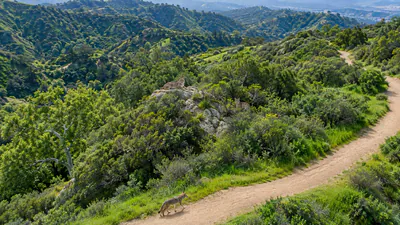
Researchers radio-collared 50 bobcats and 86 coyotes between 1996 and 2000, according to a 2003 study in Conservation Biology.
That idea might help explain a gift from 1998, when “Jeopardy!” host Alex Trebek bought land in the Hollywood Hills and donated it for public use. Los Angeles is a city of traffic, freeways, and nonstop noise. Despite all of this, bobcats and coyotes still call the area home. The authors note that for bobcats, protecting enough good open space for adult females is necessary to keep the population viable.
Researchers examined bobcats and coyotes along the Ventura Freeway, one of the busiest highways in the country, according to a 2006 study in Molecular Ecology. Using radio telemetry and DNA analysis to identify which animals had crossed the freeway, researchers found that between 5% and 32% of sampled animals crossed it over a seven-year period. The authority lists the open space at 62 acres, compared with the 74 acres reported in 1998.
Roads create another problem. Even so, crossers rarely reproduced on the other side, so the freeway still limited how much DNA moved from one side to the other. The authors suggest this may also apply to animals that migrate long distances. It is located between Runyon and Nichols canyons and borders Runyon Canyon Park. The place is currently managed by the Mountains Recreation and Conservation Authority, which is a public agency. The area can be used for hiking, mountain biking, and horseback riding.
Today, the site is called Trebek Open Space.
