
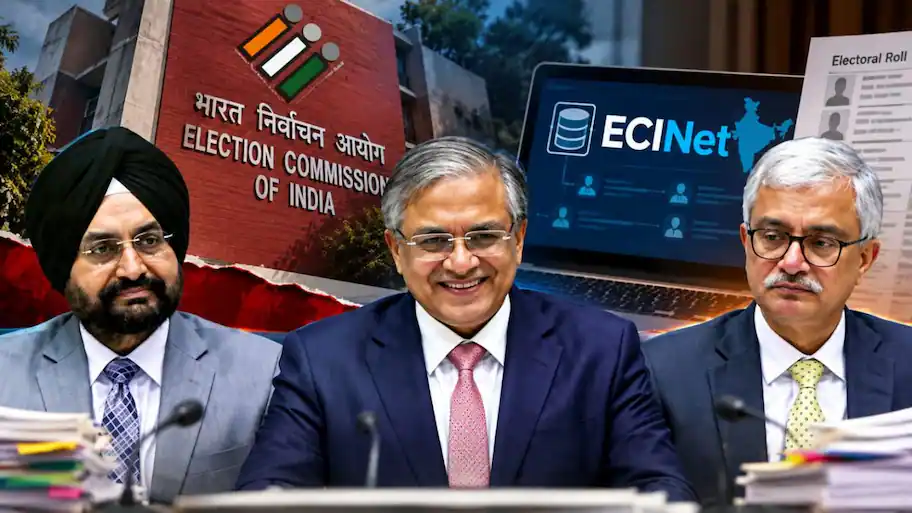
The poll body said their letters concerned the functioning of an officer on deputation and were not about an EC policy decision. The Election Commission has ordered an expert review of ECINet after a meeting of all three commissioners on Saturday, while clarifying why Election Commissioners Sukhbir Singh Sandhu and Vivek Joshi wrote separately to Cabinet Secretary T V Somanathan.
The clarification followed an Indian Express investigation that reported differences within the three-member Election Commission over electoral roll management, ECINet and decisions linked to the Special Intensive Revision, or SIR.
The report said Sandhu and Joshi wrote separately to the Cabinet Secretary after the Election Commission changed the allocation of work. The two commissioners were concerned that the changes affected oversight of the IT systems used to manage electoral rolls, according to the report. It said the letters were linked to the functioning of an officer serving on deputation and were not about a policy matter of the Commission or its IT division. The poll body also said, “The work redistribution orders issued by the concerned officer were not actually implemented after the orders of the two Commissioners and the oversight over the IT division by the DEC was never actually withdrawn. A Committee headed by Sr Deputy Election Commissioner (DEC) and including an independent expert from IIT/IIIT will review the ECINET to double-check that it complies with the provisions of the Acts and Rules and submit report to the Commission,” the Election Commission said.
The Election Commission gave a different account of what happened. The Commission has now decided to examine the system through a committee headed by a Senior Deputy Election Commissioner. An independent expert from an IIT or IIIT will be part of the review. “Field officers have role-based access to the ECINET system as per their statutory powers.
ECINet was launched on January 22 as a single platform combining more than 40 Election Commission applications and portals. The meeting came after The Indian Express reported that Sandhu and Joshi had recorded objections at least 14 times over 10 months to decisions and orders linked to electoral rolls and the SIR. The newspaper said some objections dealt with voter registration, deletion and restoration of names, Form 6 and access to the electoral roll database. Under Section 18 of the Chief Election Commissioner and Other Election Commissioners (Appointment, Conditions of Service and Term of Office) Act, 2023, the Commission’s business should, as far as possible, be conducted unanimously. The Commission has also extended the period for filing claims and objections in Delhi until October 30.
Because they are unmapped or have what the system calls logical discrepancies, the Commission also announced changes affecting voters who receive notices during the SIR.
Chief Election Commissioner Gyanesh Kumar said at its launch that the platform had been built in accordance with the law. Director General (IT) Seema Khanna said it would “enhance transparency, credibility and public trust”. The Indian Express reported that Joshi had earlier warned about the “gradual centralisation of the electoral roll database”. Sandhu later recorded concerns that state election officials did not have “proper and complete access” to the electoral roll system. The Election Commission says the system works differently. Booth Level Officers, Assistant Electoral Registration Officers, Electoral Registration Officers, District Election Officers and Chief Electoral Officers carry out their respective statutory duties through their own IDs and passwords, according to the poll body. “No one else can perform their statutory function on ECINet, including any other officer of the ECI,” an Election Commission official said earlier this week. The Commission said new IT modules and portals will first be discussed by its Committee of Officers before they are placed before the Commission for approval. The poll body said ECINet has already undergone changes based on suggestions received from Chief Electoral Officers in the states. Henceforth, all the new initiatives about IT modules and portals will be discussed in the Committee of Officers (COO) before approval by the Commission,” it said. The Election Commission said on Saturday that its decisions on the SIR, including its nationwide implementation, had received the “unanimous approval” of all three commissioners.
The decision gives the ECINet access issue a formal review process after Sandhu and Joshi recorded concerns about how electoral roll data and access were being handled. He proposed an audit involving an outside IIT expert to check that credentials allowing changes to the voter database were available only to the statutory authorities concerned. He questioned restrictions on the access available to officials who have legal responsibility for preparing and updating electoral rolls. Saturday’s decision also changes the internal process for future technology projects. “In case, any further flexibility is required by the field officers, that will be made operational. Chief Election Commissioner Gyanesh Kumar, Sandhu and Joshi were present at Saturday’s meeting. When the commissioners differ on a matter, the majority view decides it. Such voters will generally not have to appear personally at an Electoral Registration Officer’s office. Booth Level Officers will instead visit their homes, collect the required documents and upload them to ECINet. The ERO can then decide the case using those documents. Saturday’s decisions mean the Election Commission will now review the ECINet system through a committee that includes an outside technical expert while future IT projects will pass through another layer of internal scrutiny before reaching the three-member Commission.
