
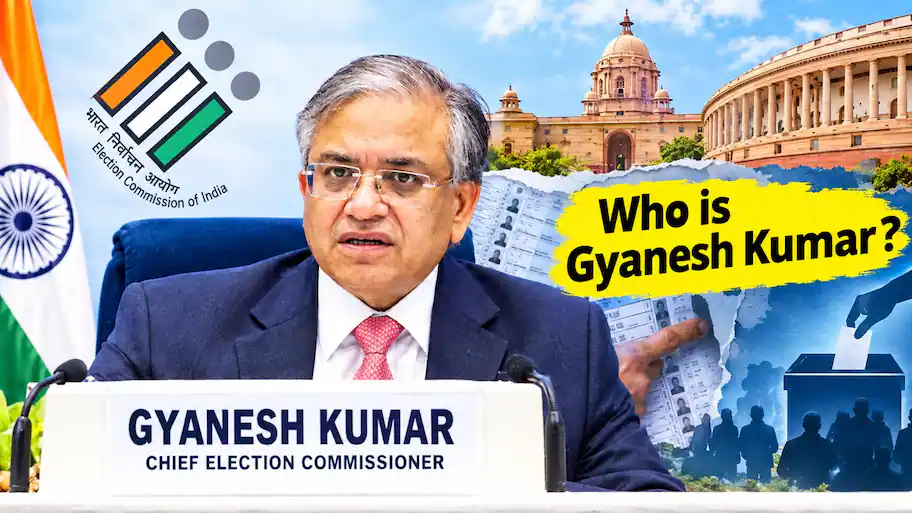
Chief Election Commissioner Gyanesh Kumar became India’s 26th CEC in February 2025, bringing decades of government service experience to the forefront. His administration has recently received a lot of media attention due to disputes between the panel members regarding the electoral rolls revision and database management.
Gyanesh Kumar, from the 1988 batch, IAS Kerala cadre officer, to India’s most important electoral position Educational qualifications : An engineer from IIT Kanpur, he pursued his studies in business finance from the Institute of Chartered Financial Analysts of India and in environmental economics from Harvard University.
Some of his important central assignments were his involvement in the abrogation of Article 370 and subsequent administrative work done by him for the setting up of the Ram Janmabhoomi Trust during his tenure in the Ministry of Home Affairs. After working as the Secretary of Ministries of Parliamentary Affairs and Cooperation, he retired in January 2024. Later in March 2024, he became an Election Commissioner of the Election Commission of India. In February 2025, he assumed the office of the 26th Chief Election Commissioner. His term would continue until January 2029. Commissioners : Apart from Kumar, Sukhbir Singh Sandhu (1988-batch, Uttarakhand cadre) and Vivek Joshi (1989-batch, Haryana cadre) form the constitutional three-person commission under the 2023 act.
Kumar’s election commission has been involved in some politics concerning the Special Intensive Revision (SIR) of voters list and the centralization of databases. Dissent report : Investigations had brought to light the fact that other commissioners, Sukhbir Singh Sandhu and Vivek Joshi, had officially expressed their dissents on decisions made without consultations. The commission position : The Election Commission argued that dissenting voices form part of the normal discussions, and the decision-making process takes into account the unanimous opinion.
