
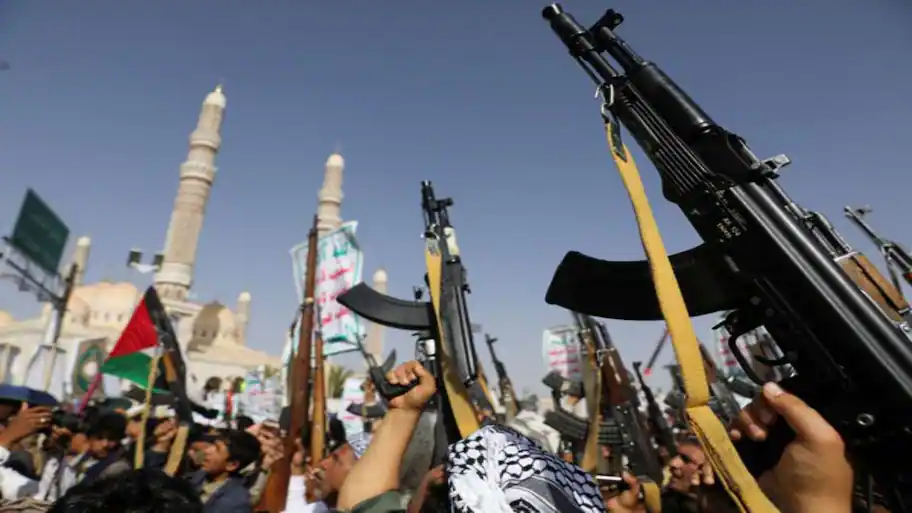
Houthi-Saudi Arabia Conflict: Britain has agreed to provide Saudi Arabia with limited, time-limited military support as the kingdom faces a new wave of attacks from Yemen’s Houthi movement. Prime Minister Andy Burnham stated that the United Kingdom will deploy an RAF Voyager aircraft to provide defensive air-to-air refuelling for Saudi jets countering drone and missile strikes.
These gains have placed the movement in a dominant position along a major international maritime chokepoint through which roughly 12% of world trade normally passes. British officials emphasised that the mission is intended purely to support air defence and secure vital energy pathways, rather than engage in offensive strikes. The decision follows recent Houthi advances along Yemen’s Red Sea coast, where the group captured the strategic port city of Mocha and Perim Island (Mayyun) near the Bab al-Mandeb Strait. Formally known as Ansar Allah, the Houthis are a Yemeni armed movement rooted in the country’s Zaydi Shia community. The group emerged from a religious revival movement in northern Yemen during the 1990s. Its name comes from Hussein al-Houthi, one of its early leaders.
Saudi Arabia intervened militarily in 2015 at the head of a coalition supporting Yemen’s internationally recognised government. A UN-mediated truce in 2022 reduced fighting, but that truce was never turned into a permanent peace agreement. Around 12% of world trade normally passes through the strait. Saudi Arabia said a ballistic missile aimed at Riyadh was intercepted on September 19. More than 100,000 people were displaced by the fighting along Yemen’s western coast by mid-September, according to the United Nations. Later estimates put the number at more than 125,000 as the fighting spread across several provinces.
The group has launched drones and missiles towards Saudi targets. The attack was the first reported Houthi attempt to hit the Saudi capital during the latest escalation. Saudi authorities also reported attacks involving drones and missiles aimed at other locations. Hezbollah has also been reported to have trained Houthi fighters. Reuters reported this month that the movement has evolved from a northern Yemeni militia into a regional military force with long-range missiles and drones. Aid agencies have reported shortages of shelter, food, clean water and medical services in areas receiving displaced people.
Saudi air defences said they intercepted and destroyed the drone before it entered the restricted airspace around the holy city. The Houthis denied targeting Mecca and said their attacks were directed at Saudi military and oil facilities. Research from the US Institute of Peace says Iran and Hezbollah have provided assistance to the movement, while Tehran has denied or downplayed some of the allegations.
The war continued for years and created one of the world’s worst humanitarian crises. The latest escalation has brought major fighting back to western Yemen. The ongoing conflict has spread across Yemen’s western coast. Houthi forces have captured Mocha and Perim Island and have advanced towards the Bab al-Mandeb Strait, which connects the Red Sea with the Gulf of Aden. The waterway is an important route between the Indian Ocean and the Suez Canal. The Houthi advance has also affected Saudi Arabia’s shipping and energy interests. The kingdom has used the Red Sea route for oil exports and other commercial traffic. Saudi Arabia has also accused the Houthis of attempting to target Mecca with a drone. The claim has added to the political and religious sensitivity surrounding the conflict. The strait connects serves as the essential gateway between the Indian Ocean and the Suez Canal. By controlling Mocha and Perim Island, Houthi forces have gained a vantage point near the narrowest stretch of the passage. This gives them significant leverage over international shipping and energy transit. Keeping these pathways open remains a primary rationale for the UK’s involvement. The Houthis have close ties with Iran, although the movement was not created by Tehran. The group emerged in Yemen before its relationship with Iran developed. Iran has been accused by the United States, Saudi Arabia and other governments of providing weapons, training and technical support to the Houthis. Research from the Middle East Institute cites reports of Hezbollah personnel providing training in areas including infantry tactics, anti-tank weapons and anti-ship operations. The Houthis have developed a large missile and drone capability. Their attacks have extended beyond Yemen, reaching Saudi Arabia and targeting shipping in the Red Sea. The latest Houthi advance has also created a new humanitarian crisis. Thousands of Yemenis also crossed the Bab al-Mandeb Strait to Djibouti in search of safety. The fighting has forced families to leave their homes with little warning.
The group became a major military force after Yemen’s political crisis deepened following the 2011 Arab Spring protests. In 2014, Houthi fighters seized Sanaa and expanded their control over large parts of northern Yemen. The movement grew during years of political and religious tensions in northern Yemen. Hussein al-Houthi and his supporters opposed the government of President Ali Abdullah Saleh and criticised what they saw as growing US and Saudi influence in Yemen. President Abdrabbuh Mansur Hadi eventually left the country. The latest territorial gains have also changed the military geography of the conflict. Houthi forces now have positions along much of Yemen’s Red Sea coast and near the Bab al-Mandeb Strait. Saudi Arabia has responded with airstrikes and has sought additional support from foreign partners. the United States has declined direct participation in this phase of the conflict, prompting Saudi Arabia to seek assistance from other international partners While Britain has agreed to provide refuelling support.
