
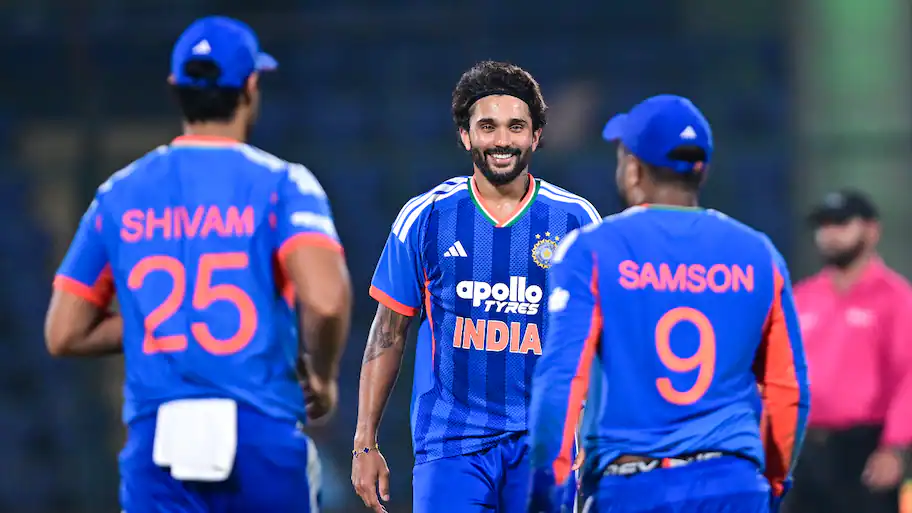
In the second T20I against Afghanistan on Tuesday at the Arun Jaitley Stadium in New Delhi, Nitish Kumar Reddy showcased his bowling prowess, taking three wickets. His performance was instrumental in limiting Afghanistan to a total of 159 runs for 8 wickets. India successfully chased down the target, winning by seven wickets and taking an unassailable 2-0 lead in the series.
Reddy, who finished with 3-24, said the work put in during his rehabilitation at the Centre of Excellence (CoE) had left him feeling confident about his fitness. The 23-year-old’s contribution came after Varun Chakaravarthy was ruled out of the remainder of the series with a side strain, leaving India without one of their key bowling options. India’s victory, powered by Sanju Samson’s 57 off 22 balls and Abhishek Sharma’s 39 off 19, secured the series with one match still to play.
Named Player of the Match, Reddy said his performance was built on trusting his ability after his recent injury setback. We have done some great work at CoE, and the body’s recovering well,” Reddy said after receiving the award. Reddy said the additional pace he has developed is part of a larger ambition to establish himself as a complete all-rounder.
“It’s good. Right now I’m feeling great. His return to bowling also provided India with a significant boost as the team continues to look for greater balance through its seam-bowling all-rounders. Reddy responded by making a decisive impact in the middle overs, where his three breakthroughs helped prevent Afghanistan from converting a steady start into a bigger total. His performance also represented a strong response after the opening T20I, where he had limited impact with the ball. “I would say it’s all about trusting your ability and making) that comeback, and I was just believing in myself. It’s a funny game; anything can change in a moment,” he stated. Reddy’s return to effectiveness with the ball gives India another encouraging option as they continue to assess the balance of their T20I side.
For Reddy, however, the emphasis was less on what had happened previously and more on maintaining belief in his own game.
